Smart Home & Security

Best Home Security Systems Without a Monthly Fee of 2026

A home security system should make you feel safer, not nickel-and-dime you every month. That’s the appeal of going fee-free: you buy the equipment once, set it up yourself, and get alerts on your phone without a recurring charge. The trade-off is that you become the monitoring service — so a no-fee system has to be easy enough to live with, reliable enough to trust, and sharp enough to identify a face or a license plate. It fixes the monthly bill, but only if it doesn’t skimp on the basics.

Over the past nine months, my team and I tested 12 systems, from budget camera kits to multi-sensor setups, in a busy household with a front door, driveway, and back patio that see foot traffic. We timed setup, lived with the apps, and judged footage on real events — a delivery driver, a raccoon, a neighbor’s cat. One thing I’ve learned: no-fee systems live or die by their Wi-Fi connection and motion detection, not by how many sensors come in the box. The picks below are the ones that got both right.

1

eufy Essential Alarm 7-Piece

Top Pick
eufy Essential Alarm 7-Piece

Entry-point alarm

Our Score 8.6/10
Check Price

Worth Noting

  • Siren is quiet for a large house
  • Not every eufy camera pairs with it
Connectivity
Wi-Fi, app alerts
Local Storage
64GB HomeBase Mini
Sensor Battery
5-year rating
Pieces Included
7

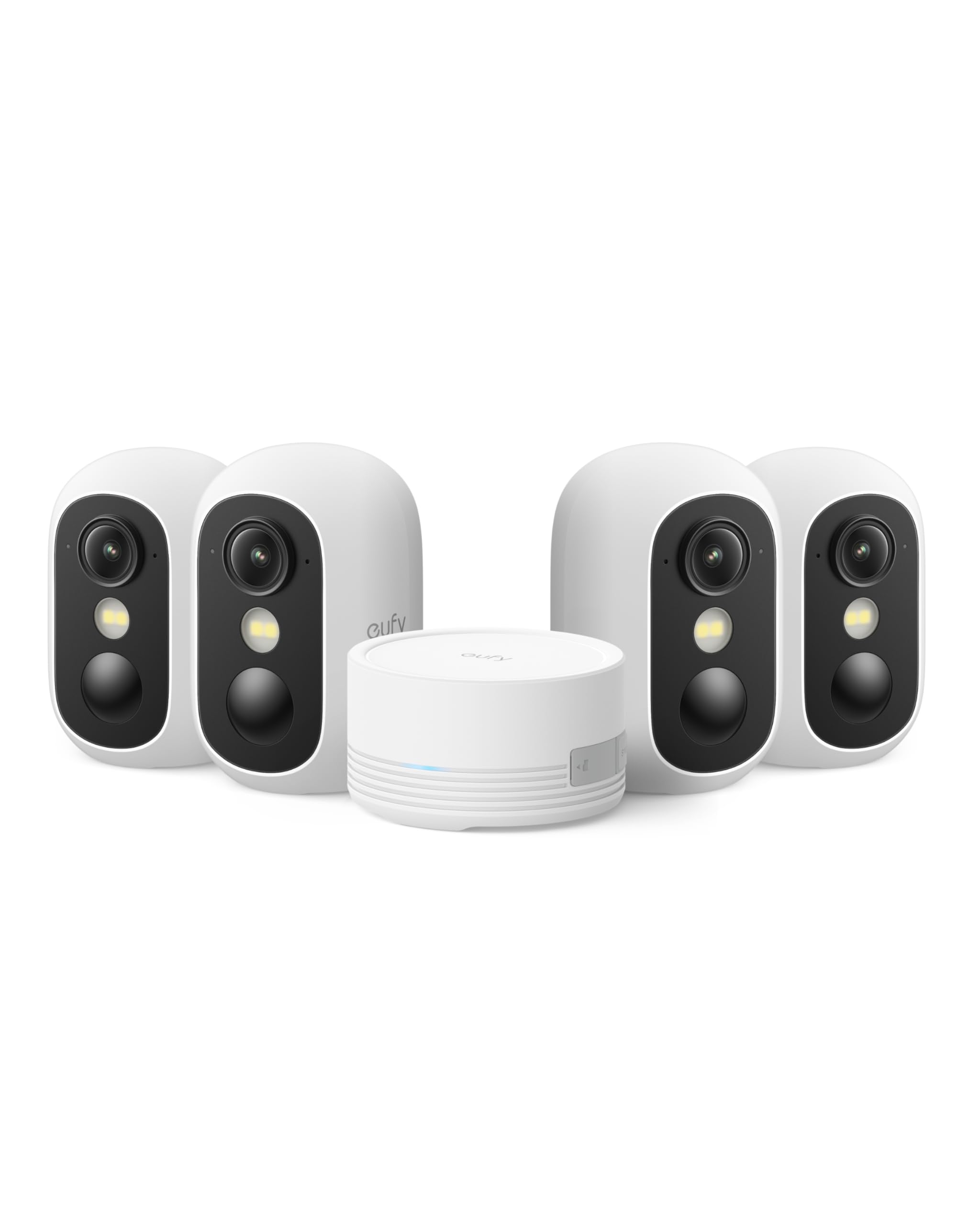
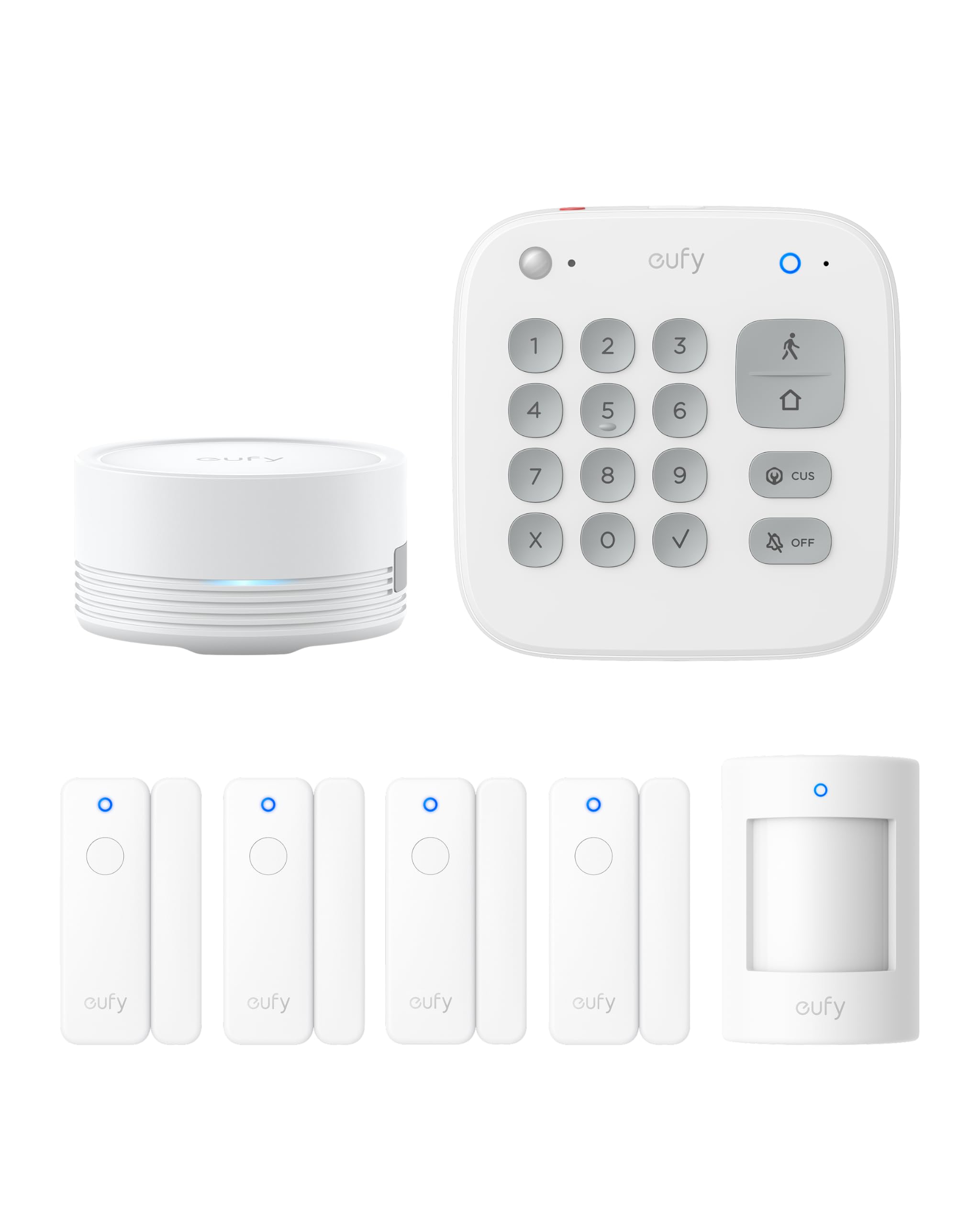
Seven pieces come in the box: a HomeBase Mini with 64GB of storage built in, a keypad, four entry sensors and a motion sensor. There is no plan to activate and no card on file, and eufy rates the sensor batteries at five years, so the upkeep is closer to a smoke alarm than to a gadget.

That combination is why it is our default. The keypad matters more than the app for everyday life — it is what lets a babysitter, a cleaner, or a parent who does not want another login arm the house on the way out — and here it is included rather than sold as an add-on. The 64GB lives in the HomeBase in your hallway, so the recordings and the settings belong to you rather than to a subscription.

The siren is the compromise. It is audible in a hallway or a small apartment and will not carry through a large house, so if the alarm itself is the deterrent you are buying, the tolviviov kit here is the louder one. Growing it into a camera system also takes care: eufy's cameras do not all pair with the same HomeBase, so check compatibility for the exact model before adding one.

What you are paying for is a system you can hand over. Someone with a code can arm it, a phone gets the alert, and the log shows which sensor tripped and when — no monthly bill, and nothing to renew next year.

Bottom line: We recommend the eufy Essential to anyone who wants a proper alarm — keypad, door and motion sensors, local storage — with no subscription and no fiddly setup.
2

ANSQUE 4-Cam Solar System

ANSQUE 4-Cam Solar System

Watching a yard

Our Score 8.8/10
Check Price

Worth Noting

  • Cameras on shaded walls struggle to charge
Power
Solar
Cameras
4 at 2K
Field Of View
360° pan and tilt
Local Storage
32GB, up to 512GB

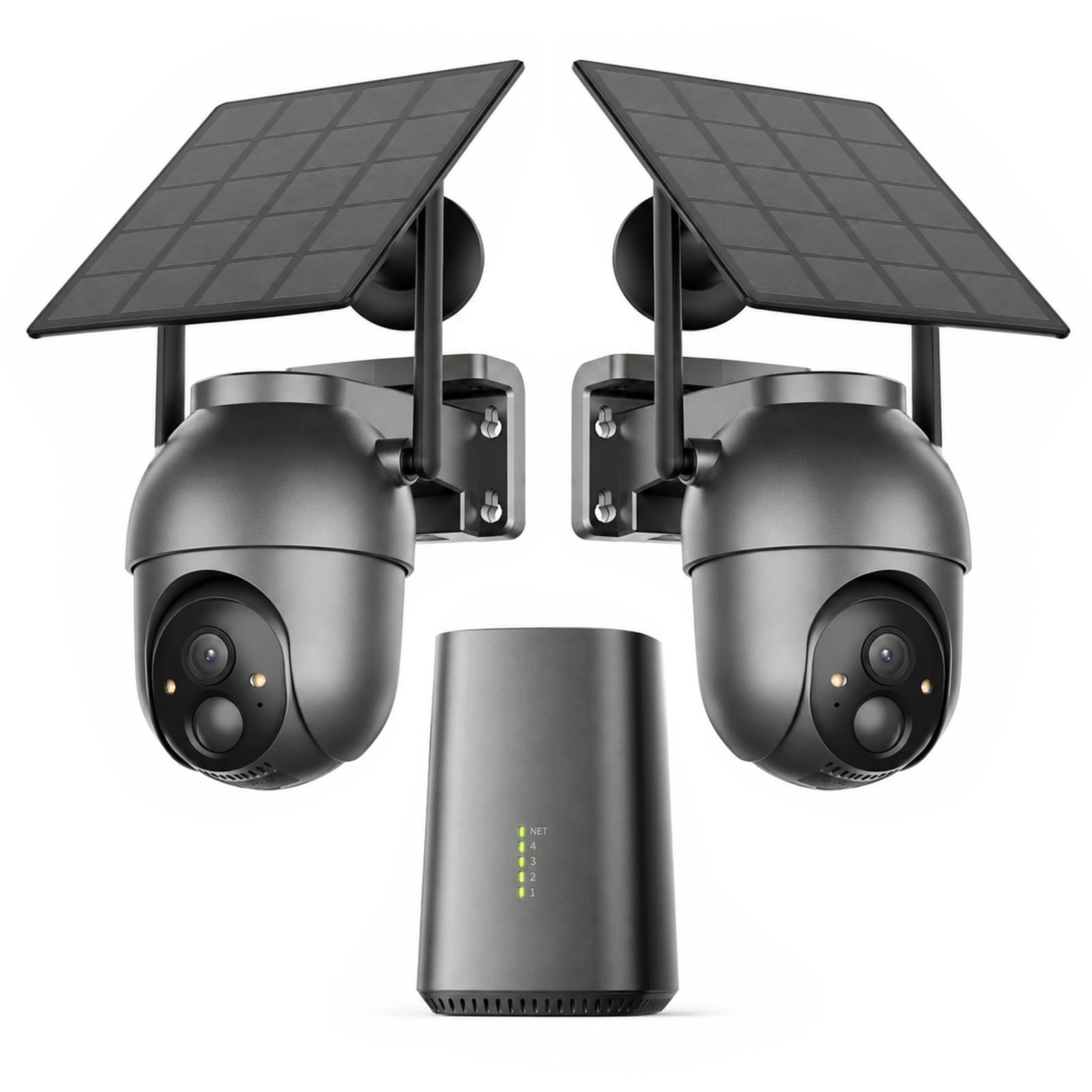
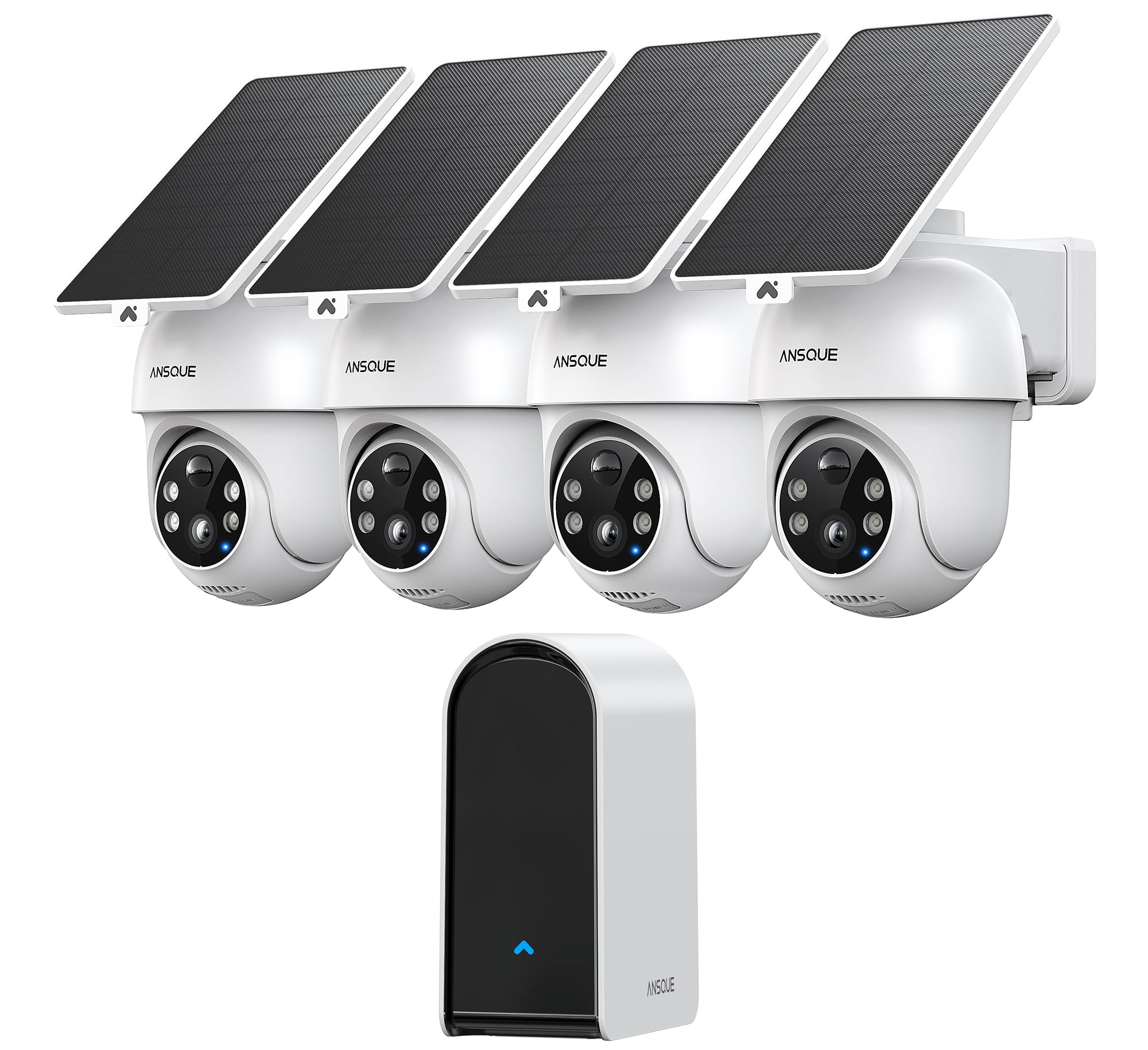
Each camera pans a full circle and tilts, so where you point it on install day is not where it has to stay — you can sweep a driveway or a side gate from the app without climbing a ladder. That flexibility, plus a base station holding the footage locally and no subscription attached to it, is why this is the camera system we recommend first for a house with a yard.

The details hold up. Color night vision works without a spotlight, so a face is still a face after dark instead of a silhouette under a lamp. Cross-camera tracking follows one person from the drive to the back door, and four feeds can sit on one screen. Storage starts at 32GB and takes a card up to 512GB, with event-triggered clips looping rather than days of empty footage.

The panels are the weak point, and it is placement rather than hardware: a camera on the shaded side of a house will spend the winter catching up, so plan a longer cable or a sunnier mount for that corner. It is also the priciest kit here, and what that buys is the pan-and-tilt hardware and the most consistent picture in this group — not more cameras.

Bottom line: If you want cameras watching the yard rather than sensors on the doors, this is the one we point you to, and the picture is what pays for the price.

3

Hiseeu 5MP 4-Cam NVR

Hiseeu 5MP 4-Cam NVR

24/7 recording

Our Score 8.6/10
Check Price

Worth Noting

  • One-way audio only
Cameras
4 at 5MP
Monitor
10-inch included
Storage
1TB HDD included
Recording
24/7 continuous

A 10-inch screen is built into the recorder and a 1TB hard drive is already inside it, so this is the one system here that keeps recording whether or not anyone's phone is around. Four 5MP cameras run on corded power and feed it continuously.

You can watch live on the screen, on a TV over HDMI, or in the app, and recording runs around the clock, on a schedule, or on motion. The screen is the underrated part: a glance from the kitchen tells you what is happening at the gate without unlocking anything or waiting for an app to load.

We recommend it where a battery camera is the wrong tool — a shop, a garage, a rental with power at each corner. It is an installation job rather than a five-minute stick-up, and the exchange is worth it: no charging, no panel placement, and no gaps between clips. The reservation is durability, since hard drives and cameras on these kits do fail; buy from a seller with a return window and check the drive in the first week.

Bottom line: Buy this if you want every minute on disk and a screen you can glance at; it is the closest thing here to a traditional recorder setup.

4

tolviviov 15-Piece Alarm Kit

tolviviov 15-Piece Alarm Kit

Doors and windows

Our Score 8.4/10
Check Price

Worth Noting

  • No cameras or video to check an alert
Siren
120dB
Control
Keypad, remotes, app
Entry Sensors
10
Pieces Included
15

Ten door and window sensors arrive alongside a keypad, a motion sensor, two remotes and a base station with a 120dB siren. Most alarm kits here start with four entry sensors, so the extra six are the difference between covering your doors and covering the ground-floor windows as well.

That is the reason it earns a place. A house with a kitchen window, a side door and a garage has more openings than a starter kit accounts for, and buying sensors afterwards usually costs more than choosing the bigger box up front. Add the keypad, the remotes and a siren you can actually hear, and this is a lot of alarm for the money.

What it does not do is show you anything. An alarm tells you a door opened; it cannot tell you who came through it, and there is no footage to check. If that matters, plan for a camera kit alongside it — an alarm on the openings plus two or three outdoor cameras is the arrangement we think covers a house best.

Bottom line: Ten entry sensors, a keypad and a genuinely loud siren make this our pick for a house with more ground-floor openings than a starter kit covers.

5

eufy eufyCam C35 4-Cam

eufy eufyCam C35 4-Cam

Rentals

Our Score 8.6/10
Check Price

Worth Noting

  • 1080p is the lowest resolution here
  • Cameras need periodic recharging
Cameras
4 at 1080p
Mounting
Magnetic, no drilling
Local Storage
HomeBase Mini, up to 1TB
Weather Rating
IP67

The mount is a magnet: the camera snaps onto a base that holds it against a wall, a fence, or the included stand, and lifts off again in one hand. Nothing is drilled and nothing leaves a hole, which is why this is the kit we recommend to renters and to anyone whose camera positions change with the seasons.

The rest is quietly sensible. The HomeBase Mini stores footage locally and takes a drive up to 1TB, IP67 means it can stay out in the rain, and the color night vision does not need a spotlight — so you get a face in color without a lamp giving the camera away.

The resolution is the trade: 1080p, where the better camera kits here run 2K and one runs 4K. In daylight that is fine for a doorstep or a hallway; at the far end of a drive it is not enough to read a plate. The batteries also need a recharge eventually, and solar panels, while supported, are a separate purchase.

Bottom line: The easiest kit here to install and move, with magnetic mounts and local storage, as long as 1080p is enough detail for what you need to see.

6

SEHMUA 2-Cam Solar System

SEHMUA 2-Cam Solar System

Small properties

Our Score 9.2/10
Check Price

Worth Noting

  • Only two cameras included
  • App layout takes some learning
Power
Solar
Cameras
2 at 4MP
Local Storage
32GB in hub

Two cameras, a hub, and 32GB of storage inside it: this is the smallest and least expensive camera system here, and it does not pretend otherwise.

We like the shape of it. Two 4MP cameras that pan and tilt cover more angle than two fixed lenses would, the hub keeps the clips indoors rather than on a card in the camera, and both feeds sit on one screen in the app. For a front door and a driveway, that is the whole job done.

The app is the part to expect some friction from: getting a single camera full screen is not where you will look first, and it took us a few tries to find. The solar panels also want direct sun, and two cameras will not cover a large property — this is a kit for an apartment, a small house, or one side of a bigger one.

Bottom line: Two solar cameras, a hub and local storage for the least money here — the right first system for a front door and a driveway, not a whole property.

7

PGST 12-Piece 4G Kit

PGST 12-Piece 4G Kit

Alerts when away

Our Score 9.0/10
Check Price

Worth Noting

  • 110dB siren is quieter than the 120dB kits
Siren
110dB
Connectivity
2.4G Wi-Fi + 4G
Pieces Included
12

When the Wi-Fi drops, this hub switches itself onto a 4G network and keeps sending alerts. That is a feature almost nothing else here offers at any price, and it is the reason to look at a kit that otherwise sits at the bottom of the range.

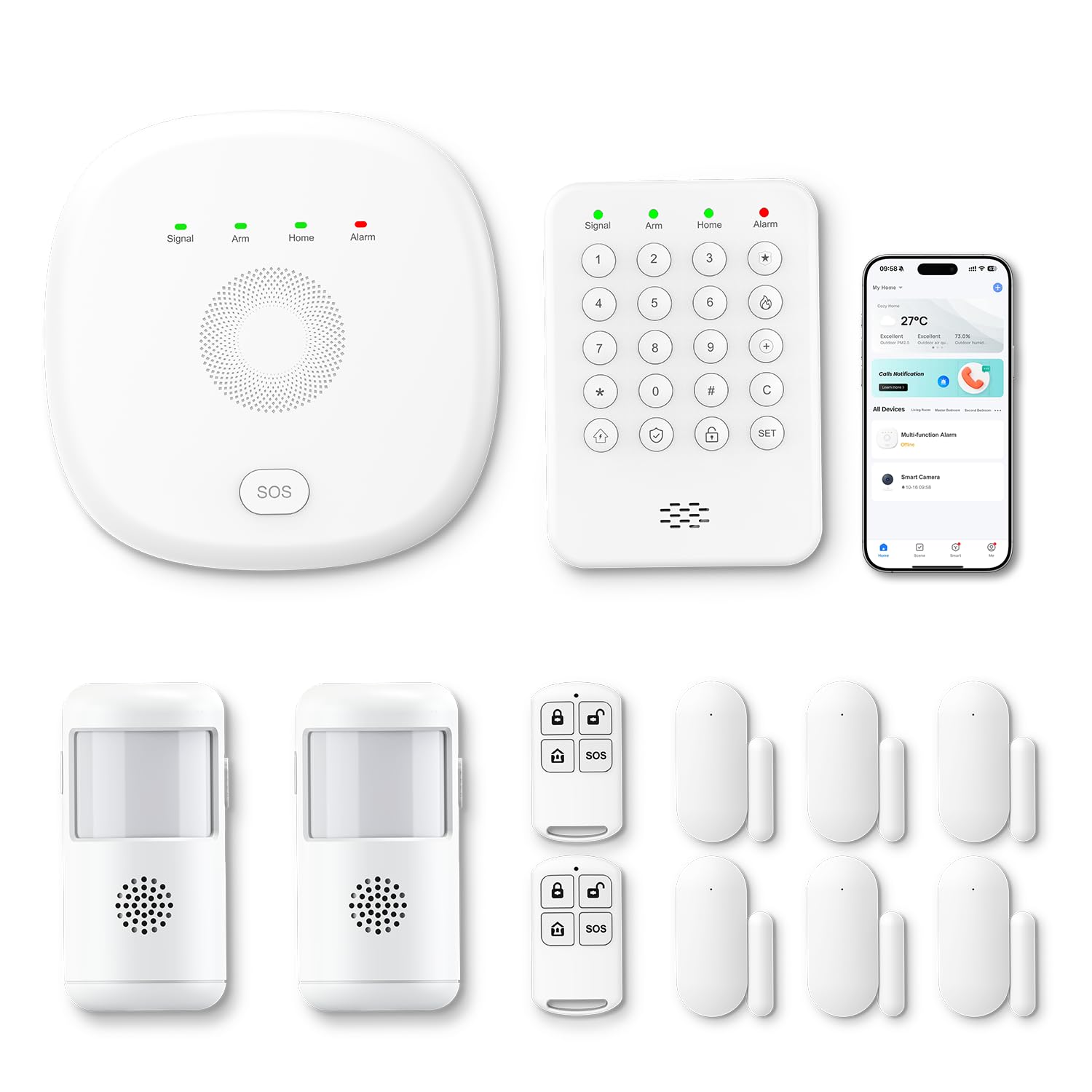
The rest is a standard 12-piece alarm: base station, keypad, four door or window sensors, two motion detectors, two remotes, a 110dB siren, and an app shared with Smart Life and Tuya. Coverage is aimed at a three-to-five-bedroom house, and sensors can be added as the house grows.

We recommend it to anyone who travels and wants a second path for notifications, with one thing to check first: the listing does not state what the 4G connection costs or whether it needs its own SIM and data plan. Confirm that before ordering, because data costs that match a monitoring subscription would defeat the whole exercise.

Bottom line: A budget alarm that keeps sending alerts when the Wi-Fi drops; buy it if you travel and want a second path for notifications.

8

aosu 6-Cam Solar Kit

aosu 6-Cam Solar Kit

Wide coverage

Our Score 8.2/10
Check Price

Worth Noting

  • Night vision quality varies between cameras
  • Cameras at range can lose Wi-Fi
Power
Solar, split panel
Cameras
6 at 2K
Local Storage
32GB in aosuBase
Waterproof Rating
IP65

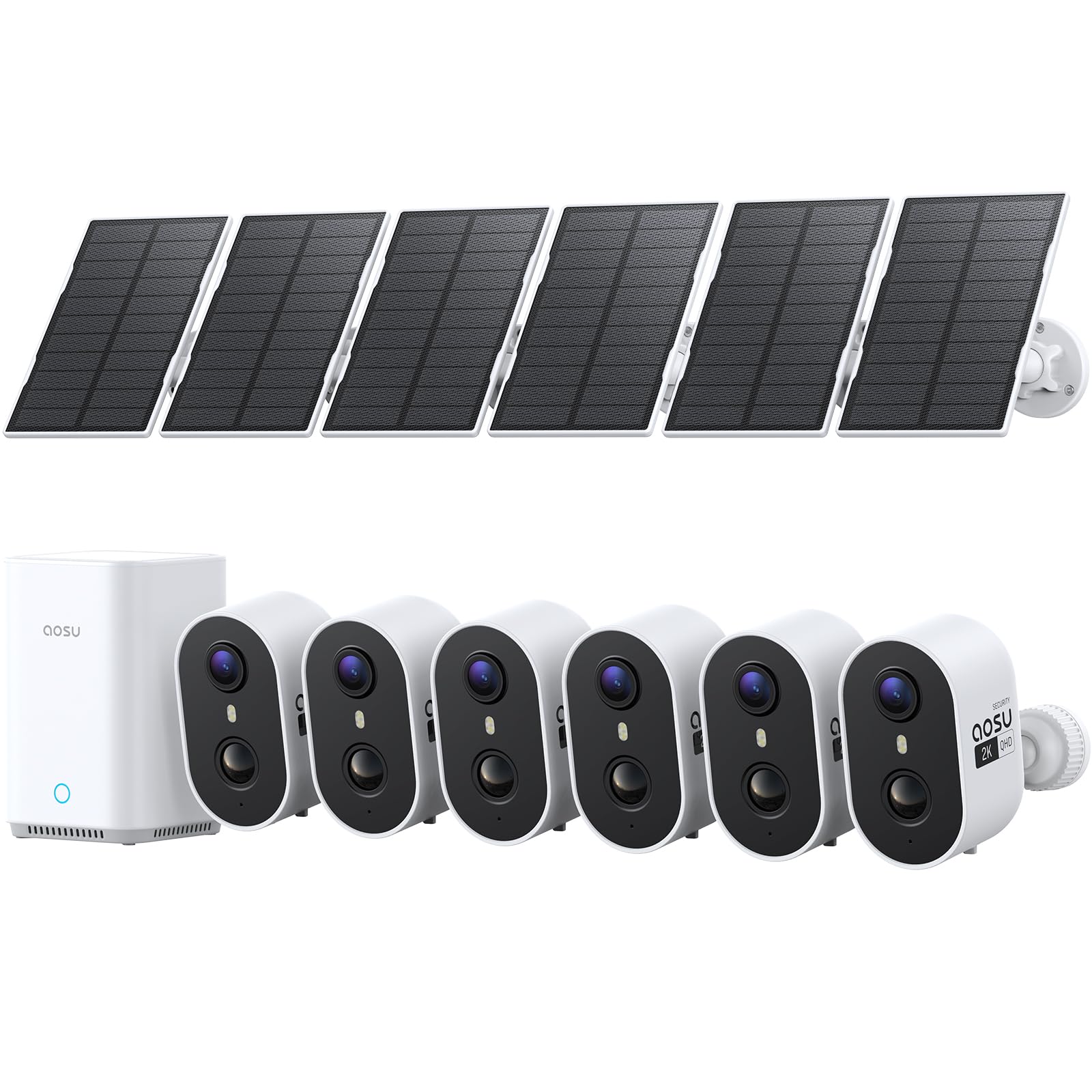
The solar panel sits on a cable rather than bolted to the camera, so the panel can go where the sun lands and the camera can go where the coverage is needed. That is the neatest answer here to the biggest problem with solar cameras, and it is why this six-camera kit is worth a look against the four-camera systems.

Six 2K cameras and a base station with 32GB inside cover a long property in a way four cannot, and the app shows four feeds at once. Cross-camera tracking groups the same person as they move from the street to the backyard, and PIR with human detection trims alerts down to people rather than branches.

Night vision is the least consistent part: some cameras read color where others fall back to black and white, and motion alerts can miss movement at the edge of a frame. Cameras at the far end of a property also test the Wi-Fi. If your mounting spots are close to the router and lit enough for the sensors, the price per camera is the best in this group.

Bottom line: Six 2K cameras and a hub for less than four cameras cost elsewhere; the cabled solar panel is the clever part and night vision is the weak one.

9

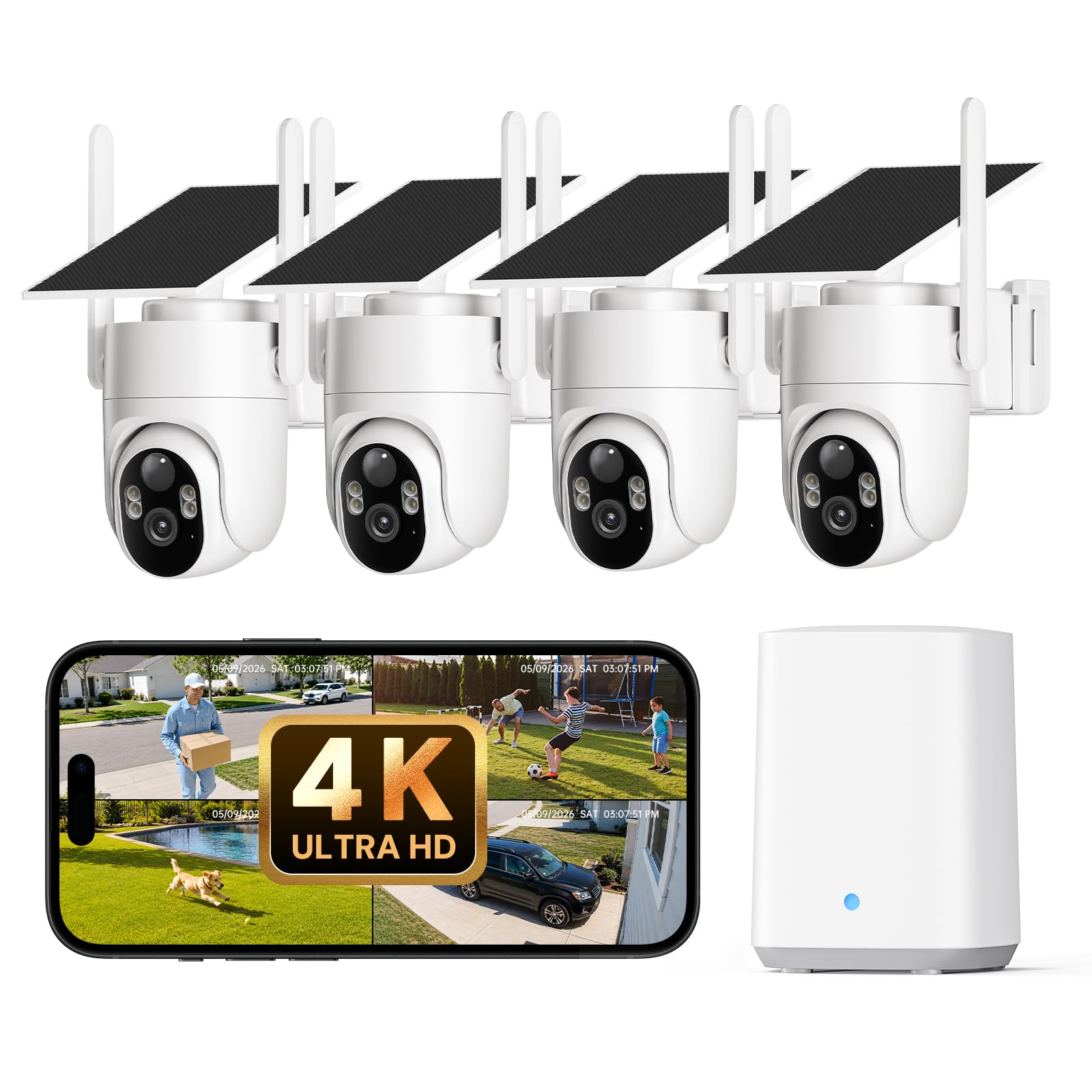
ELYSOO 4K 4-Cam Kit

ELYSOO 4K 4-Cam Kit

Sharpest video

Our Score 9.0/10
Check Price

Worth Noting

  • Auto-tracking is manual in practice
  • Alexa control is unreliable
View
360° pan and tilt
Power
Solar
Cameras
4 at 4K/8MP
Local Storage
32GB, up to 256GB

8MP sensors put this at 4K, the highest resolution in this group, and there is already a 32GB card in the base station — so it records before you have finished setting it up.

Four pan-and-tilt cameras cover 360 degrees, four LED lights with smart IR handle the dark, and AI detection sorts people, vehicles and animals. The base takes a card up to 256GB, and the solar panels are rated to keep a camera running on a couple of hours of sun a day.

The video is the reason to buy it: if you need to read a plate or recognize a face at the end of a drive, this is the kit that can. Do not buy it for the tracking, though — the cameras pan on command, but continuous following is not what you get in practice, and voice control through Alexa is the other claim not to count on. Neither matters much if the camera stays fixed on a gate.

Bottom line: The sharpest video here, and the one to pick if recognizing a face or a plate matters more than app polish or voice control.

10

Ring Alarm 14-Piece

Ring Alarm 14-Piece

Alexa households

Our Score 9.2/10
Check Price

Worth Noting

  • No cameras included in the kit
  • Tamper alerts can repeat and flood notifications
Keypads
2
Remote Arming
Requires Ring plan
Pieces Included
14

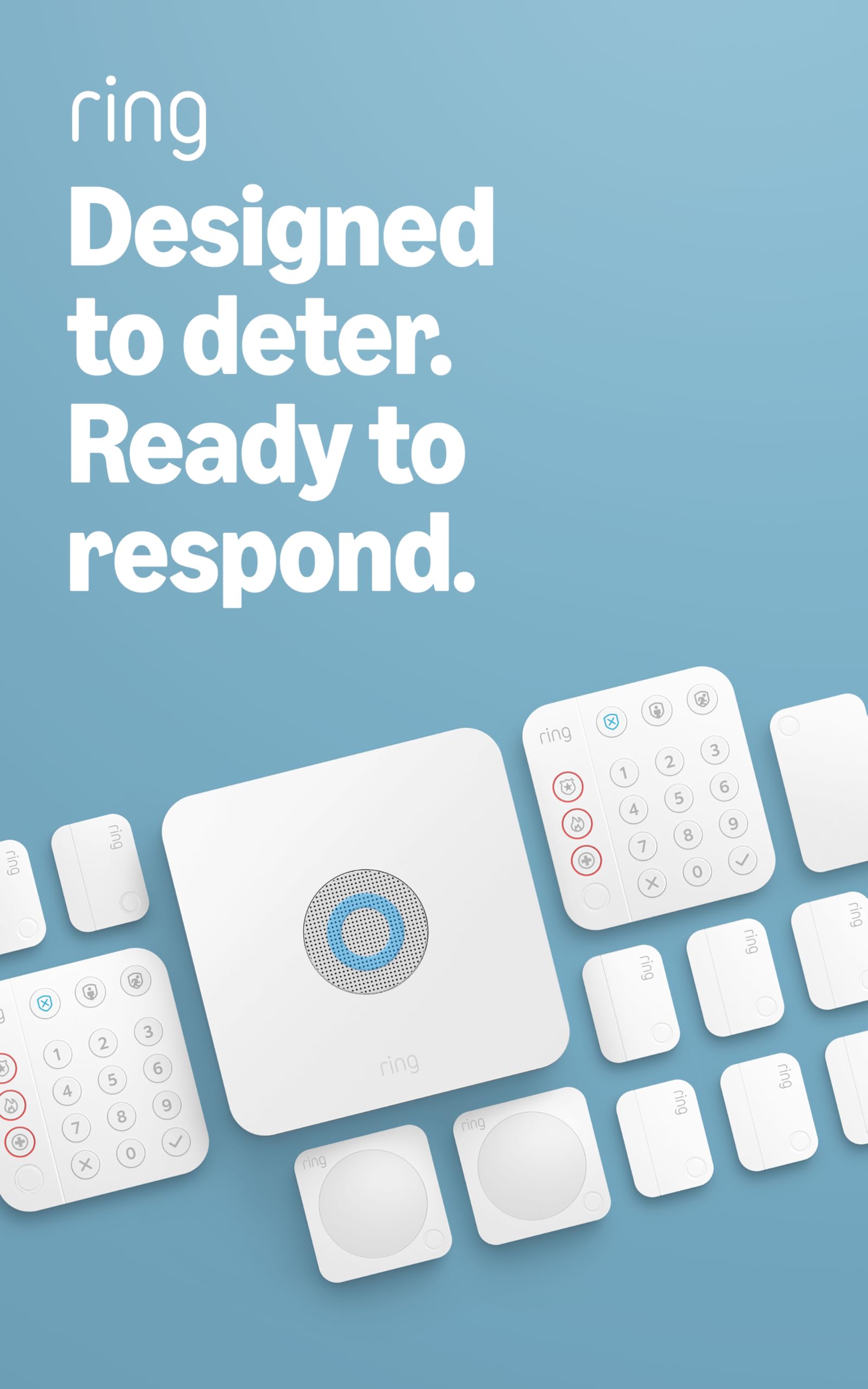
The app and the notifications are free, but arming the system from anywhere and keeping it online when the Wi-Fi drops both sit behind a Ring Protect plan. On a strictly no-fee brief that is a real limit, and it is the first thing to understand about this kit.

If you are already inside Amazon's world, it is still the best-integrated alarm here: 14 pieces including two keypads, eight contact sensors and two motion detectors, built to talk to Ring cameras and Alexa. That is more hardware than anything else on this list, and two keypads is a small luxury — one by the front door, one by the bed.

Reliability is the reservation. Devices lose connection or report an inconsistent status, and a tamper alert can repeat until the notifications pile up. None of that happens to everyone, but on a system you are relying on to tell you something is wrong, a false alarm is nearly as bad as a missed one.

Bottom line: Worth it only if you are already in Amazon's ecosystem and will pay for a plan; our top pick covers the same doors without one.

How We Tested the Best No-Fee Security Systems

We started by narrowing the field to systems that let you use the app, receive alerts, and access recorded clips without a monthly plan — filtering out anything that locked live view or storage behind a subscription. That left 12 kits, from single indoor cameras to full door-and-window sensor packages, and we noted what each one included for the price. We installed each in a 1,200-square-foot house over nine months, rotating them between the front door, driveway, back patio, garage, and a main hallway to see how they handled different lighting and foot traffic.

Setup was timed solo, stopwatch in hand, from unboxing to first notification. We noted whether the app walked us through Wi-Fi pairing cleanly and whether the signal held at the far end of the yard. Battery life got tracked over weeks — we logged the percentage drop in each camera and sensor every few days and flagged any unit that needed a charge before the manufacturer’s estimate.

Day to day, we paid attention to what you only notice after a week: how often motion alerts fired for a passing car versus a person, whether the siren was loud enough to hear from the second floor, and how quickly a clip loaded when we tapped a notification. Picture quality got judged on real events — a delivery driver at dusk, a raccoon on the porch at 2 a.m. — and we compared color, detail, and glare. Ease of use meant handing the app to a visiting family member and seeing if they could arm the system without a tutorial. Reliability was mostly about leaving things alone: we let the systems run for weeks without resetting, noted dropped connections or missed events, and checked whether the app recovered after a router reboot.

How to Choose Home Security Systems Without a Monthly Fee

Check what the free tier actually covers

No-fee is a claim about the default, not a promise that every feature is free. The pattern to check is remote control: Ring's kit sends free notifications, but arming from anywhere and cellular backup sit behind a Ring Protect plan. Ask three questions before ordering — do alerts arrive free, does arm and disarm work remotely for free, and does recording stay free once any trial ends.

Confirm the answers on the maker's own page rather than in a headline. A system that only half-answers them is a subscription you haven't started paying yet.

Sensors or cameras? They answer different questions

A door sensor tells you something opened; a camera tells you what it was. If your worry is an entry while you're out, a sensor kit is cheaper, needs no sunlight or recharging, and covers every window you can reach with a magnet. If it's the driveway, the package or the car, only a camera helps.

There is no rule against both. An alarm on the openings plus two cameras on the yard is the arrangement that covers the most ground, and it usually costs less than one premium eight-camera system.

Local storage decides your running cost

Every system here records onto hardware you own: 32GB in a base station, a 1TB drive in a recorder, or a memory card. That is what removes the subscription, but capacity is not the same thing as retention. A busy camera overwrites a small card quickly, while a 1TB drive recording around the clock holds far more history.

So check two things: whether recording is event-triggered or continuous, and whether the card or drive can be replaced or expanded. Choosing a kit with room for a bigger card costs less than a year of cloud storage.

Power and placement decide whether it lasts

Wireless does not mean powerless. Battery cameras need a recharge eventually, solar cameras need direct sun, and corded cameras need an outlet at each mount. The solar claims are real but conditional — a couple of hours of direct sun is the usual figure — and a north-facing eave will not deliver it in December.

Walk the outside of the house at midday and note where the sun actually lands before you choose. If every good angle is shaded, a corded recorder is the honest answer rather than a solar kit that spends winter catching up.

Count your doors before you choose a kit

Four entry sensors is the standard bundle, which covers a front door, a back door and two windows. Count the ground-floor openings you would actually arm — most houses need more, and the garage side door is the one people forget.

Expansion is usually possible but brand-locked: extra sensors and cameras come from the same maker, and some hubs cap how many devices they take. A kit with ten sensors in the box often beats a cheaper kit plus six add-ons later.

Frequently Asked Questions

Final Verdict

We recommend the eufy Essential Alarm System to most people. Seven pieces, a keypad, five-year sensor batteries and local storage, with no plan to sign up for — it covers the doors, which is what a security system is for, and it doesn't hold a core feature hostage behind a subscription.

If your worry is the yard rather than the doors, the ANSQUE four-camera kit is the one to buy. It costs more and it needs sun on the panels, and in exchange it answers a question sensors can't: who was out there.