Smart Home & Security

Best PoE Security Camera Systems of 2026

A PoE camera system does one thing differently from the Wi-Fi cameras most people start with: a single Ethernet cable carries both power and video, so each camera draws its electricity from the same cord that sends footage back to a recorder. No ladder-and-outlet math, no battery to climb up and charge every few months, no camera dropping off because the doorbell crowded the 2.4GHz band. What that cable buys you is a feed that stays up, and a recording that lives on a drive in your house rather than on someone else's server — which is exactly what people searching for a real system are trying to get to.

The trap is that PoE kits look nearly identical on a spec sheet and behave very differently once installed. Resolution is the number everyone compares and the one that matters least if the recorder can't keep up, and a cheap switch will brown out the moment you add a second camera to a long run. My team has spent the past nine months living with six PoE systems — mounting them, running cable, and watching what happens at 2 a.m. — and the gap between the good ones and the frustrating ones shows up in the app, not the box.

1

Reolink 5MP 8CH 4-Camera Kit

Top Pick
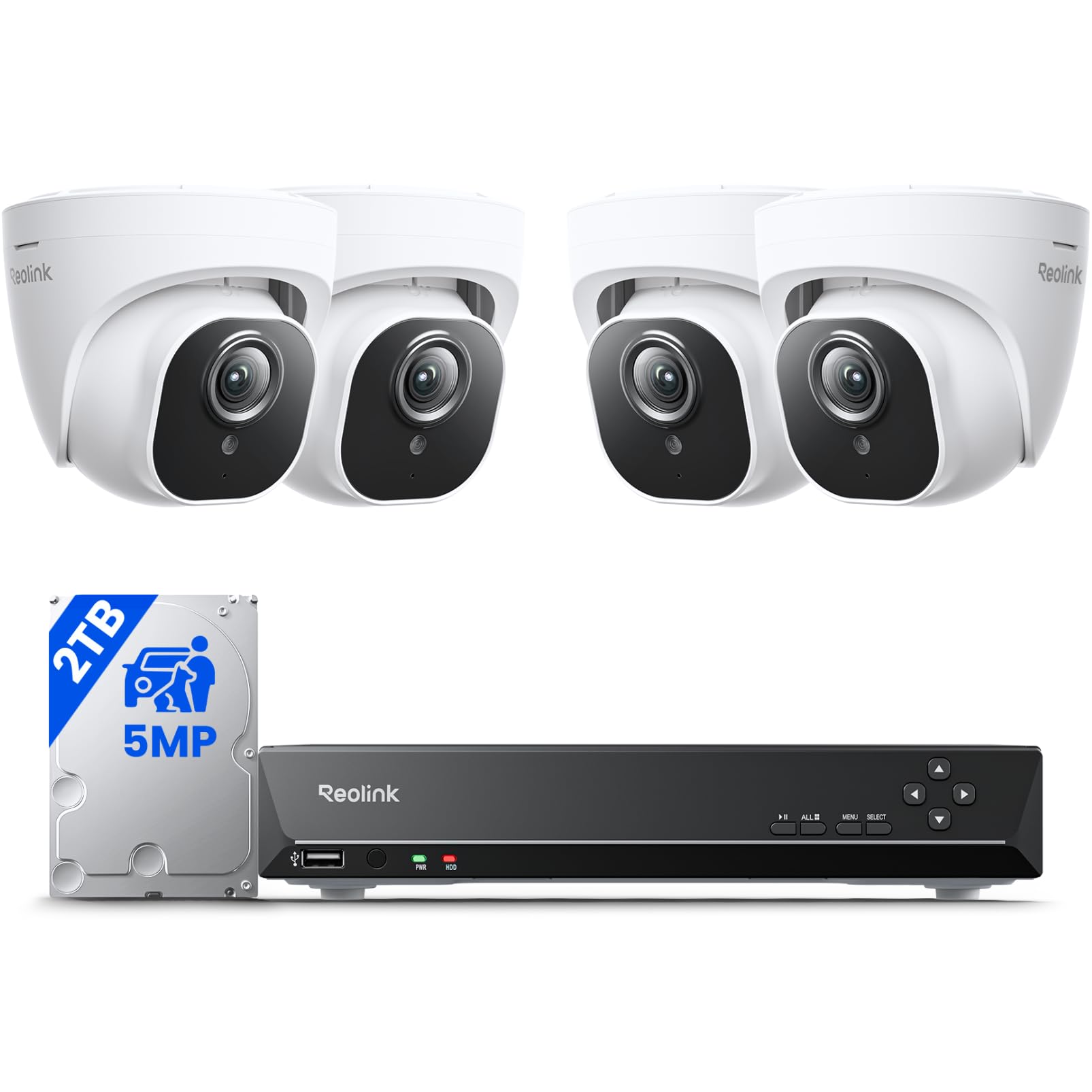
Reolink 5MP 8CH 4-Camera Kit

Most homes

Our Score 8.8/10
Check Price

Worth Noting

  • Remote viewing can drop and need reconnecting
  • About ten days of continuous recording on the 2TB drive
Storage
2 TB HDD
Channels
8
Resolution
5MP (2560 × 1920)
Cameras Included
4

Four cameras, an eight-channel recorder, a 2TB drive already installed, and four 60-foot network cables arrive in one box. Kits are sometimes a pile of parts with a discount attached; this one is genuinely complete, and that's most of why it's the system we recommend first. Half the recorder's channels are still empty, so a side gate or a shed gets added later without replacing anything.

Our instinct with any security kit is to push for the highest resolution on the box. Here we don't. At 2560 × 1920, a 5MP camera identifies a face at conversational distance and reads a plate at the end of a short drive, and the smaller files leave more days on the same drive. Point one of these at a gate 80 feet away and you'll want more resolution; point them at a front door, a driveway and a back patio, which is what most houses actually need, and 5MP is the sensible place to sit.

Alerts are where a system earns its keep or gets muted. Raw motion detection flags leaves, insects and headlights, and this kit is no exception until you spend a little time in the settings: switch on person and vehicle detection, draw the motion zone over the walkway instead of the whole frame, and drop the sensitivity a notch. After that the phone stops buzzing at branches. The built-in microphones add sound to the recording, which turns out to matter when you're trying to work out what happened.

Each camera runs on a single cable that carries both power and data, which is the whole appeal of PoE: no outlet, no adapter and no battery at the far end of the run. Night vision is rated to 100 feet and, like every IR camera here, looks best when there's a wall, a fence or a parked car for the light to bounce off rather than open lawn. The IP67 housings are the rating we look for on anything staying outside through a winter.

Bottom line: For most homes this is the PoE kit we point people to: four cameras, a full recorder and a drive in one box, with room to grow.
2

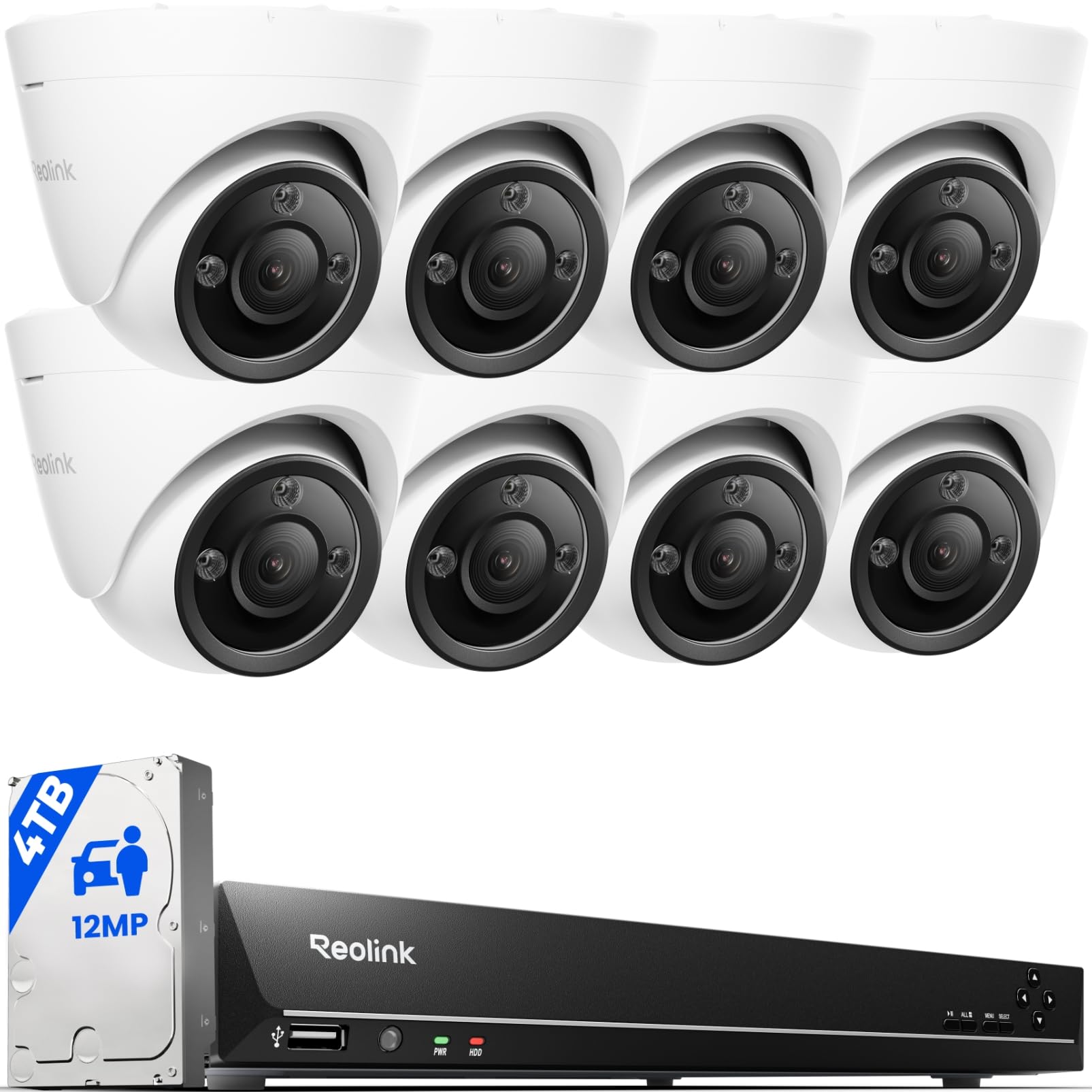
Reolink 12MP 16CH 8-Camera Kit

Reolink 12MP 16CH 8-Camera Kit

Large properties

Our Score 8.8/10
Check Price

Worth Noting

  • The most expensive system in this group
  • 12MP files eat 4TB faster than 4K would
Storage
4 TB HDD
Channels
16
Resolution
12MP (4512 × 2512)
Cameras Included
8

Twelve megapixels is well over twice the pixel count of our top pick, and the difference shows up in the job that matters most after an incident: reading a detail nobody knew they'd need. A face at the end of a long driveway, a plate on a car turning out of a gate, the logo on a jacket — those are the frames where the extra resolution earns its keep.

More resolution usually means more of everything, and here it does: eight 12MP cameras, a 16-channel recorder with 16 PoE ports, and 4TB of storage. Whether that's worth paying for depends entirely on distance. If every camera watches something within 30 feet, our top pick does the same job for a lot less. If one camera has to cover a gate at the far end of the property, this is the kit that gives you a usable frame instead of a smudge.

The spotlights are the other thing that separates it. Color night footage is far easier to make sense of than grey IR — a car's color, a coat, a door left open — but those lights do illuminate the yard, and a neighbor with a bedroom window facing your drive will notice. Scheduling the spotlight for the evening and falling back to IR after midnight is the compromise most people settle into. Two-way talk lets you answer a delivery from the phone, and detection covers people, vehicles and pets.

Two practical notes before you order. The cameras are built to plug into the recorder's own PoE ports rather than a separate switch, so plan the wiring around wherever the recorder lives. And run all eight cameras on a bench before anything goes on a wall — with this much hardware in a single box, the first month is when a bad unit shows itself, and sorting that out is far easier with the camera in your hand than on a ladder.

Bottom line: Buy this when your cameras look a long way down a drive or across a yard and a face at 80 feet still has to be identifiable.

3

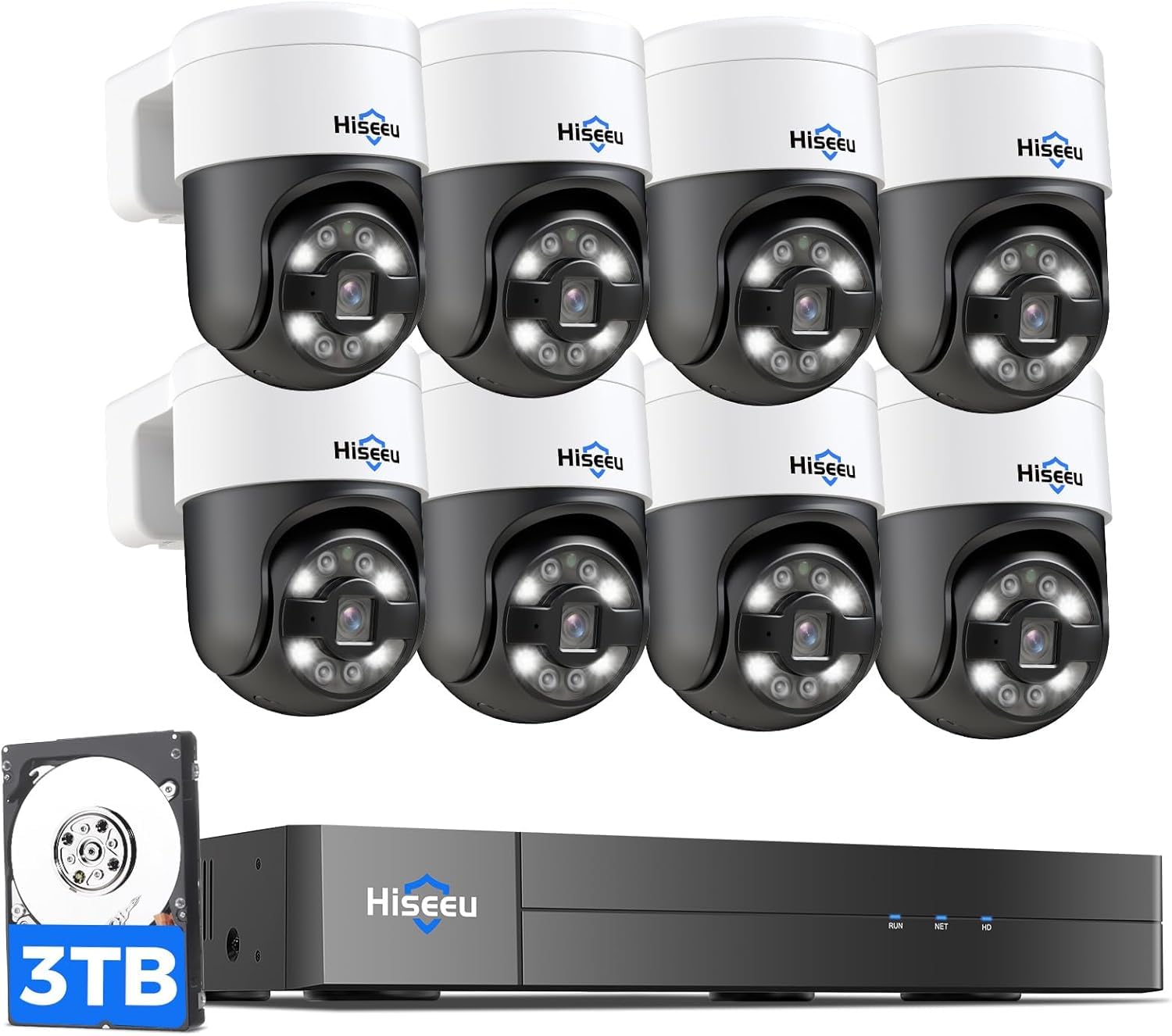
Hiseeu 5MP PTZ 8-Camera Kit

Hiseeu 5MP PTZ 8-Camera Kit

Tracking coverage

Our Score 8.6/10
Check Price

Worth Noting

  • All eight PoE ports are used by the included cameras
Storage
3 TB HDD
Channels
16
Pan And Tilt
300° pan, 90° tilt
Cameras Included
8

Nearly every camera on this page points one way and stays there. The eight in this Hiseeu kit pan 300 degrees and tilt 90, and the recorder can follow a person as they cross the frame — the closest thing here to having someone else watch the screen.

For a long side yard, a driveway that runs the length of the house, or a business frontage, that's a real advantage: one camera sweeps ground it would take three fixed ones to cover. It's also the most hardware per dollar here, with 3TB of storage and two-way audio on every camera.

The catch is what tracking actually gives you. A camera that follows is a camera that can be facing the wrong way when something happens behind it, and eight PTZs aren't automatically better than eight fixed views if what you need is a doorway watched every second. Set a home position for the cameras covering entrances, keep tracking for open ground, and the two behaviors stop competing.

The moving head is also the part that has to last, and it's the first thing we check on a PTZ: run each camera through its full travel on the bench before mounting it, then look again a few weeks in, while the ladders are still familiar. The 5MP images and 100-foot color night vision are the same standard as the rest of this group, and IP66 bodies are fine for year-round weather.

Bottom line: Choose this when you need cameras that follow movement across a yard or forecourt; you get eight tracking cameras for the least money here.

4

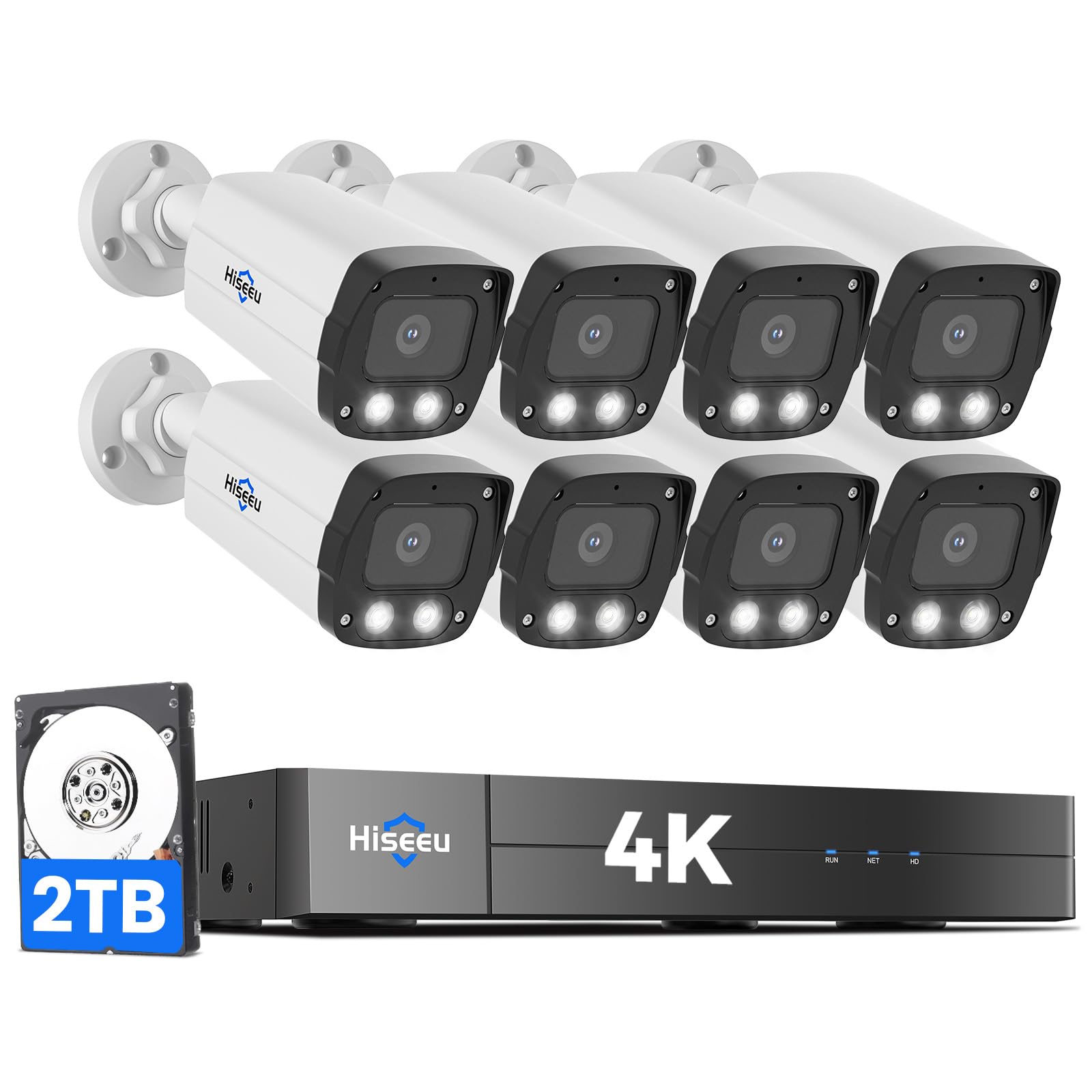
Hiseeu 4K 8-Camera Kit

Hiseeu 4K 8-Camera Kit

Wide coverage

Our Score 8.4/10
Check Price

Worth Noting

  • All eight channels filled; no room to add
  • 2TB is thin for eight 4K streams
Channels
8
Resolution
4K 8MP (3840 × 2160)
Viewing Angle
121°
Cameras Included
8

A 121-degree lens is about half again as wide as the 80-degree cameras on most kits here, and this box puts eight of them in your hands. Pointed at four sides of a house, that's a camera on every wall for roughly what a four-camera system costs.

The trade is faces. A wide lens gathers more scene and less detail per person, so the figure at the far end of the drive reads as a person and not much more, while a tighter camera in the same spot gives you something you could hand to the police. Coverage and identification pull in opposite directions, and eight wide cameras land firmly on the coverage side.

We think that's the right call for a shop front, a rental, or a house where the worry is what happens along the far fence rather than who's at the door. The alarm light and siren also give the system a way to react in the moment instead of only recording, which is more deterrence than most kits at this level offer. Setup is quick in the way these kits usually are: cameras plug into the recorder, the app finds the system, and the fiddling is in the alert settings rather than the install.

Bottom line: If covering every side of a building matters more than the sharpest picture on four, this gets eight 4K cameras up for about four-camera money.

How We Tested the Best PoE Security Camera Systems

We started by pulling every PoE kit we could find that included a recorder and at least four channels, then filtered on the things that decide whether a system is usable: PoE standard (802.3af or at), how much power the bundled switch actually budgets per port, whether the NVR accepts third-party ONVIF cameras, and how much storage you get before you're buying drives separately. That cut the field to six systems, which we installed at a house with a long gravel driveway and ran for nine months.

Setup was timed, solo, from box open to first live view on a phone, and we noted every place we had to go back to the manual — how the app discovered the recorder, whether cameras needed manual IP assignment, and how long it took to name and arrange six channels. We mounted cameras at a front door, over a garage, along a side yard, and at the back of the house, with cable runs from 25 to 110 feet, checking each feed for dropouts and whether the switch held power to all ports at once.

Picture and video quality we judged by walking the same path at noon, at dusk, and at 30 feet in near-darkness, watching whether faces held detail or smeared, whether porch lights blew out the frame, and whether IR washed a license plate into a white rectangle. Motion detection got tested on a windy Saturday, when every tree branch in frame triggers an alert — we counted false notifications against real ones and checked how fast a genuine alert reached the phone. We also pulled the router to confirm recording continued locally, scrubbed the timeline to see how quickly we could find a specific minute, and checked how many days of footage each system held before overwriting. There's no battery to worry about here, but we did cut power briefly to see whether recording survived and how cleanly each system came back.

How to Choose PoE Security Camera Systems

Channels and cameras: leave room to grow

Channel count is the ceiling on everything else. An eight-channel recorder with four cameras leaves four ports free, which covers most houses; a 16-channel recorder is for a building that will end up with more than eight views. The trap is a kit that already fills every channel it has — the eight-camera Hiseeu system here uses all eight of its ports, so a ninth camera means a new recorder, not a new cable. If adding cameras later is even a possibility, buy the headroom now.

How much resolution you actually need

Resolution buys identification at distance, not a better picture overall. At door, driveway and patio range, 5MP gives you a face you can recognize; 4K and 12MP start earning their money when one camera has to cover a gate or a back fence 50 to 80 feet away.

Sharper is not automatically better after dark, either. Night image quality depends more on how much infrared light reaches the subject and what it bounces off than on pixel count, which is why a 5MP camera facing a wall can look better at 2 a.m. than a 12MP one pointed at open lawn. Spend on resolution where the sightline is long.

Plan the cable runs before you order

PoE means one cable per camera carrying both power and data, so nothing needs an outlet at the far end. It also means every camera home-runs to the recorder, and the recorder needs a cable to your router. The included lengths set the practical limit — 60 feet with the Reolink kits, a mix of 20 and 30 meters with the Hiseeu ones — so measure your longest run first and buy cable if you come up short.

The plug-and-play promise covers configuration, not the drilling. Budget an afternoon per camera if the walls are finished and the attic is tight.

Storage and how far back you can go

Capacity decides your history. Two terabytes across four 5MP cameras is roughly ten days of continuous recording; the same 2TB shared by eight 4K cameras is far less. Motion-triggered recording stretches any drive a long way, at the cost of gaps in the timeline.

If going back a month matters — a break-in discovered after a trip, a dispute with a contractor — buy the kit with the bigger drive, like the 4TB in the 12MP Reolink, or plan to add storage rather than discovering the limit afterward.

Alerts you will not mute

Raw motion detection triggers on leaves, insects, headlights and rain, and a phone that buzzes all night gets silenced within a week, which is worse than no alerts at all. Look for person and vehicle detection, motion zones that mask the street and the trees, and a sensitivity control you can actually find.

Mounting matters as much as software. A camera pointed across a road picks up every passing car, and one wedged under an eave is blinded by its own infrared bouncing back.

Frequently Asked Questions

Final Verdict

The Reolink RLK8-520D4-5MP is the system we recommend first, and the reason is fit rather than flash: four cameras, a recorder with a drive already inside, one cable per camera, and four empty channels for the gate you will want to add next year. Most houses never need more than that.

Pay for the 12MP Reolink kit if your property is long enough that a face at 80 feet has to hold up, and pick the Hiseeu PTZ system when movement across open ground matters more than a fixed view of the door. If a camera on every wall counts for more than the sharpest four, the eight-camera Hiseeu kit is the coverage play.