Smart Home & Security

Best Home Security Systems of 2026

A home security system should make you feel calmer, not send your heart racing every time a raccoon trips the motion sensor. The right one is quiet when nothing is happening, loud when it matters, and clear about what’s going on without burying you in notifications. It turns a vague, middle-of-the-night worry into a simple routine: arm it before bed, get a useful alert when a door opens, and check in from your phone when you’re away.

Over the past nine months, my team and I have lived with six systems—DIY kits and professionally monitored setups—in a mix of houses and apartments. We armed and disarmed them daily, watched how they handled pets and kids, and paid attention to what actually annoys people: false alarms, spotty Wi-Fi, and subscription fees. The best ones weren’t the flashiest; they were the ones that set up without a fight and stayed reliable. Here’s what earned a permanent spot by the front door.

1

SimpliSafe 8-Piece

Top Pick
SimpliSafe 8-Piece

Most houses

Our Score 9.0/10
Check Price

Worth Noting

  • Remote arming and alerts stop when Wi-Fi drops
  • Remote app features narrow sharply without a plan
Siren
95 dB
Monitoring
Optional 24/7, no contract
Kit Contents
Base station, keypad, 4 entry sensors, motion sensor, panic button
Motion Coverage
35 ft, 90 degrees

Eight pieces sounds like a lot until you count what a normal house needs to watch. Four entry sensors take the front door, the back door, and the two ground-floor windows beside them; the motion sensor takes the hallway; the keypad goes by the door; the base station goes wherever the router is. Then there's the panic button, which is the small extra we appreciate most — it's the piece you reach for at two in the morning without first finding your phone.

The monitoring arrangement is what earns it the top spot. Professional monitoring is optional, monthly and contract-free, so the alarm is complete on day one and you can add a monitoring center for a vacation and drop back to self-monitoring afterwards without replacing a single sensor. We also like how little it asks of the building: the base station plugs in, the sensors are battery-powered, and nothing needs wiring or a drill, which is why it suits a rental as readily as a house you own.

The hardware itself is deliberately modest. The siren is rated at 95 dB — genuinely unpleasant in a hallway, not built to be heard three houses away, and quieter on paper than the 120 dB units further down this list. Motion coverage is 35 feet at 90 degrees, which is one room rather than a floor, and the pet rating stops at 60 pounds.

So the case for it isn't raw hardware, it's the whole arrangement: monitoring you can turn on and off, a kit that covers the openings most houses actually have, and a setup you can finish before dinner. If you never want a monthly bill, eufy's local storage is the cleaner answer; if your problem is ten windows on a tight budget, tolviviov covers more for less.

Bottom line: Our pick for most homes: a complete kit, contract-free monitoring you can switch on for a trip and off again, and the simplest install of the group.
2

eufy Essential 7-Piece

eufy Essential 7-Piece

No-fee setups

Our Score 8.6/10
Check Price

Worth Noting

  • Alarm can be hard to hear from another floor
  • No HomeKit, and pairs only with some eufy hubs
Monitoring
No monthly fee required
Kit Contents
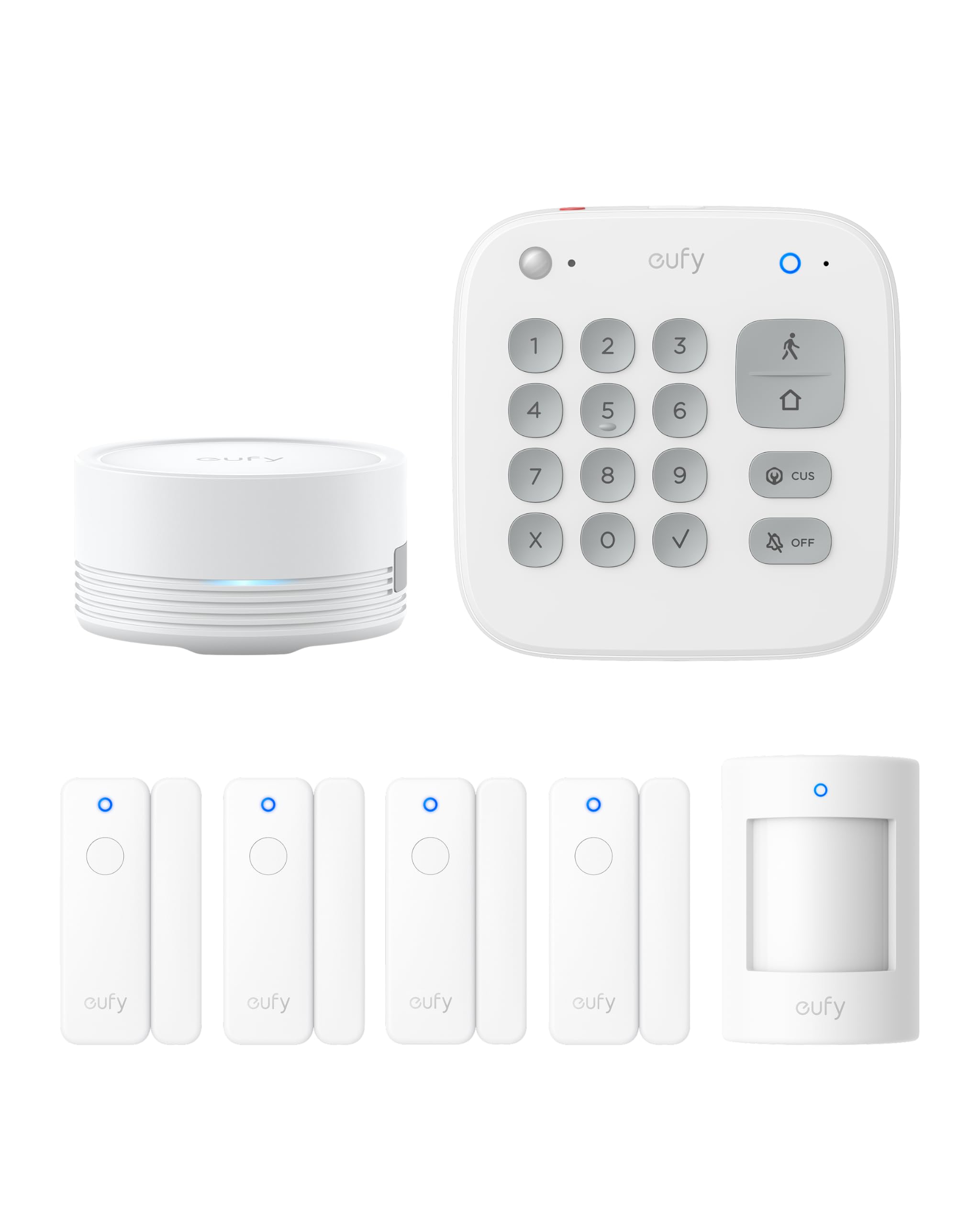
HomeBase Mini, keypad, 4 entry sensors, motion sensor
Local Storage
64GB
Sensor Battery
Up to 5 years

The alarm is the first thing to know about. The HomeBase Mini's siren can be hard to hear from another floor, and where you put the unit matters more than any setting — a back room or a cupboard turns the loudest mode into a muffled beep. That's an odd compromise in a security system, and it's why this is our pick for people who refuse a subscription rather than our overall one.

Everything around that compromise is smart. There's no monthly fee at all: the HomeBase Mini holds 64GB locally, so event history lives on your shelf rather than someone else's server, and the app controls stay with you whether or not you ever pay anything. The sensors are rated for up to five years on a battery, the longest figure here, and the kit grows with eufy cameras and additional sensors.

Compatibility is the part to check before ordering. This system is built around the HomeBase Mini and doesn't work with every eufy generation — some hubs won't talk to it — and there's no HomeKit support at all. If you already own EufyCam gear, match the hub model first rather than assuming the alarm joins the app you already use.

It's also the most expensive kit here, and the whole case for paying that rests on what you don't spend afterwards. Across several years of avoided monitoring fees the math turns in its favor; if you're renting for twelve months and moving on, it doesn't, and a cheaper self-monitoring kit does the same job.

Bottom line: Buy it if a monthly bill is the dealbreaker: local storage, no subscription, and a five-year sensor battery rating — just don't expect the siren to carry.

3

tolviviov 15-Piece

tolviviov 15-Piece

Rentals, many doors

Our Score 8.4/10
Check Price

Worth Noting

  • Self-monitoring only, with no professional option
  • Alerts can fail to arrive on some phones
Siren
120 dB
Monitoring
No monthly fee required
Kit Contents
Base station, keypad, 10 door sensors, motion sensor, 2 remotes
Wireless Range
100 feet

Fifteen pieces, ten of which are door and window contacts — that ratio is the entire pitch. The kits above it here give you four contacts and expect a motion sensor to cover the rest; this one lets you treat a ground floor as a perimeter, with a sensor on the back door, the front door and every window in between, instead of choosing which two openings are worth protecting.

Setup is the least fussy of the group in our experience: the sensors go on with adhesive strips, the base station plugs in, the app walks the pairing, and Alexa handles arming by voice. The siren is rated at 120 dB, loud enough to be genuinely unpleasant if you open the back door before you disarm, and there's no subscription waiting at the end of the first month.

The single motion sensor is the trade-off hidden inside those ten contacts. Rooms with no window in them stay unwatched, so the shape of this kit is a perimeter with a hallway covered — which happens to be right for an apartment, a small rental, or a house where the ground floor is the whole worry. We also like that two remotes are included, because it means someone without a smartphone can arm it from the driveway.

Bottom line: Ten door sensors, a 120 dB siren and no subscription — the best value here if your house has more openings than it has rooms.

4

PGST 24-Piece

PGST 24-Piece

Cellular backup

Our Score 9.0/10
Check Price

Worth Noting

  • Box contents aren't itemized by sensor type
  • Cellular service terms and costs aren't stated
Power
Battery powered
Siren
120 dB
Connectivity
2.4GHz Wi-Fi plus 4G
Kit Contents
24 pieces

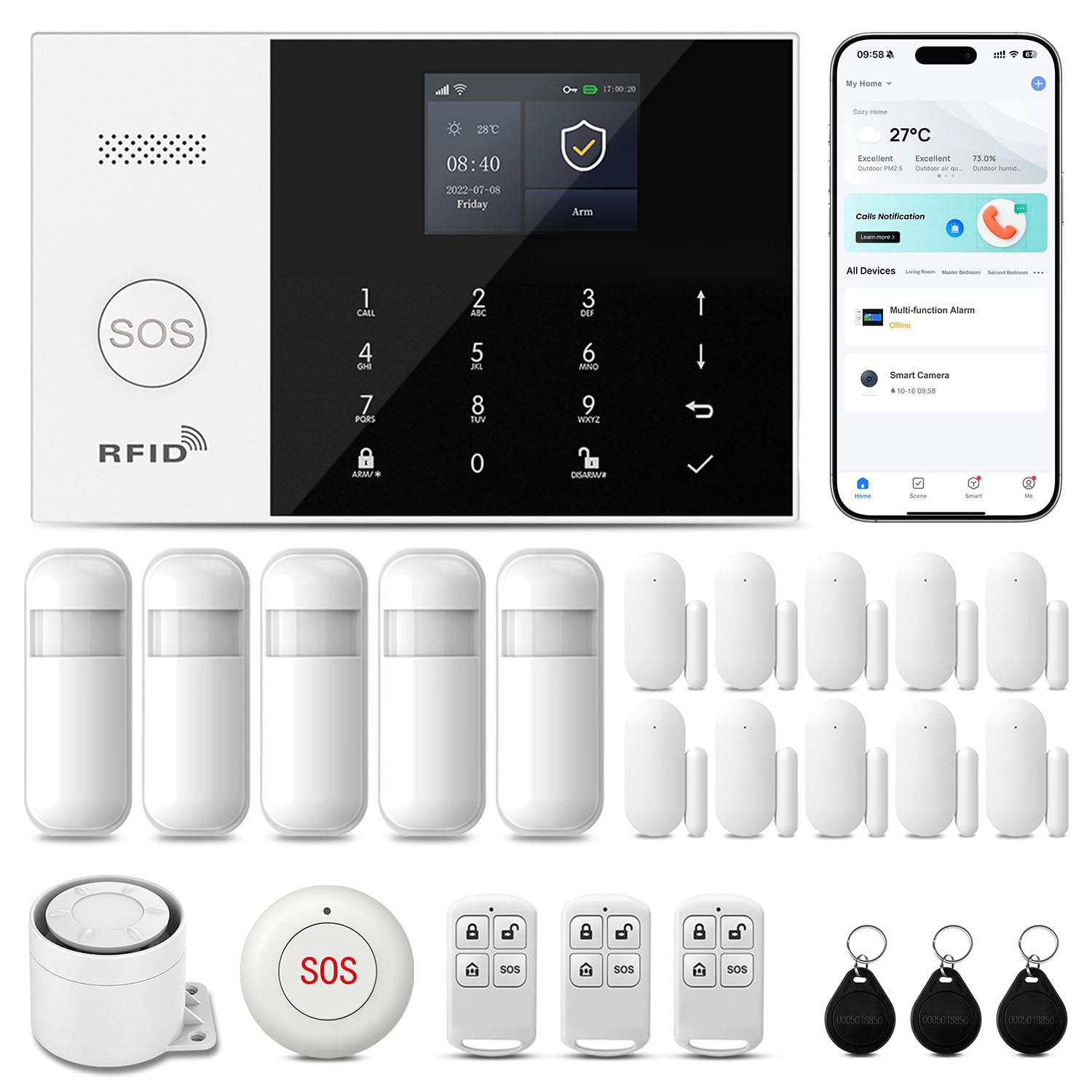
Twenty-four pieces is the biggest box here, and the feature the others can't match sits in the same breath: the PGST connects over 2.4GHz Wi-Fi and over 4G. In a house where the router lives in the basement and the alarm lives in the hall, a second path off the property speaks directly to the weak spot the rest of this list has to work around.

We're more cautious than the spec sheet invites. The 24 pieces aren't broken down by type, so work out how many of them are door contacts before you buy for a specific house — a big count isn't the same as coverage. And a 4G radio needs a SIM and a data allowance from somewhere, which the no-fee promise may not cover; confirm what the cellular side costs in year two before you treat this as subscription-free.

The rest reads well. There's a 120 dB siren, tamper protection that fires if someone pulls a unit off the wall, self-adhesive mounting, and the Smart Life app with Alexa and Google for voice arming. Battery power throughout means no wiring, and the whole thing undercuts the SimpliSafe and eufy kits by a wide margin.

It's the kit here we know least about, and that's the honest reason it sits behind the others: a short track record, unstated cellular costs, and a piece count that doesn't tell you what you're getting. For someone who enjoys the setup as much as the result — testing each sensor, watching the app, adding pieces over time — that's a reasonable gamble at this price. For everyone else, the extra money buys certainty.

Bottom line: Interesting on paper: Wi-Fi plus a 4G path, 24 pieces and no subscription, but it's the least proven kit here and the cellular terms need checking.

How We Tested Home Security Systems

We started by narrowing a list of more than 30 systems down to six, filtering for equipment costs, monitoring options, and whether they worked in both apartments and houses. Each system was installed in a real home—a one-bedroom apartment and a three-bedroom house with a fenced yard—and lived with for nine months. We timed setup from unboxing to first armed state, noting whether the app walked us through sensor placement or left us guessing.

Day to day, we armed and disarmed each system morning and night, set schedules, and adjusted sensitivity to see how customizable the rules really were. We tracked every false alarm, logging what triggered it—a 60-pound dog, a cat, sunlight through a window—and how easy it was to fix. We turned off the Wi-Fi router for an hour to test cellular backup, walked to the far corners of the house to check sensor range, and paired each system with smart speakers and cameras to see what worked without a subscription.

Notifications got their own scrutiny: we measured how long an alert took to reach our phones and whether it included a useful clip or just a vague “motion detected.” We stood in the hallway and listened to each siren, noting whether it was piercing enough to wake us or just annoy the neighbors. And we tallied the first-year cost—equipment plus monitoring—to separate genuine value from cheap hardware with expensive monthly fees.

How to Choose Home Security Systems

Professional monitoring or self-monitoring

These kits split into two models, and it's the first decision to make. With professional monitoring, a center receives the alarm and can dispatch help while you're asleep, at work, or on a plane; you pay monthly, and SimpliSafe sells it month to month with no contract, which is the most flexible arrangement in this group. Without it, the siren sounds locally, your phone buzzes, and the response is whatever you can organize from wherever you are.

We think it comes down to how often the house is empty. If you travel, live alone, or keep a second place, the plan is the point of the system and the hardware is secondary. If someone is usually home and you mainly want a loud deterrent plus a record of what happened, a no-fee kit like the eufy or tolviviov does that job for nothing after the purchase.

Count openings, not pieces

The number to count before you shop is openings: every door and every ground-floor window a person could get through. Entry contacts are the cheap part of any kit and the part that tells you which opening was disturbed. A motion sensor buys one room's worth of coverage — 35 feet at 90 degrees on the SimpliSafe — and it can't tell you which window moved.

So read the box by shape, not by total. Four contacts and one motion unit is a starter for an apartment. Ten contacts and one motion unit, as on the tolviviov, is a perimeter for a house with a lot of ground-floor glass, at the cost of leaving interior rooms uncovered.

Wi-Fi is the weak link

Every system here leans on your home network to arm remotely and push alerts, and every one of them can lose it. When the base station drops off the router, the siren still works — what stops is everything you'd want while you're out. Put the base a room or two from the router rather than in a metal cabinet in the basement, and check whether the kit lists a second path.

PGST is the only one here that lists a 4G radio alongside Wi-Fi, which is the right idea for a network outage and only useful once you've confirmed what the cellular service costs. A system that tells you it's offline beats one that goes quiet, so test the alert path in the first week while you're standing in the same room.

Where the siren sits matters more than its rating

Listed volume runs from 95 dB on the SimpliSafe to a claimed 120 dB on the tolviviov and PGST kits, and past a certain point the number stops being what you notice. Placement decides whether you hear it at all: a base station in a basement or a back bedroom is a siren for the basement.

Put it on a landing or in a hallway that reaches the bedrooms. If your house is long or the doors are solid, check whether the brand sells an add-on siren before you rely on one box — the base unit alone is doing less work than the rating suggests.

Frequently Asked Questions

Final Verdict

Buy the SimpliSafe 8-piece if you want the whole job done: enough sensors for a typical house, monitoring you can switch on for a vacation and cancel when you're back, and an install that needs no drill and no afternoon. That combination is why it's the default here, even with a 95 dB siren and a motion sensor that covers one room rather than a floor.

The eufy kit is the answer when a monthly bill is the thing you can't justify — you trade siren volume and some camera compatibility for local storage and near-zero running costs. For ten windows on a tight budget, tolviviov covers more openings than anything else here; PGST is for a tinkerer who wants a cellular second path and will read the manual.