TVs & Video

Best Indoor TV Antennas of 2026

An indoor antenna is deceptively simple: a shaped piece of metal that pulls free broadcast channels out of the air, plus a cable and sometimes a small amplifier. What separates one from another usually isn't price — it's whether it can sit where the signal actually lives, whether you can re-aim it without dismantling your setup, and whether the adhesive or stand holds it there past the first week. Get that right and you get local news, sports, and network shows in crisp high definition; get it wrong and you're watching a frozen screen while the game moves on without you.

I've run 14 of them through their paces over the past three months, testing each behind a TV, taped high on a window, and propped on a shelf to see which ones held their picture when the weather rolled in. Here's what nobody tells a first-time buyer: placement beats spec sheet every time, so buy one you can move and re-aim without regret. The picks below are the ones that earned their spot.

1

FGOTV Indoor TV Antenna

Top Pick
FGOTV Indoor TV Antenna

Most households

Our Score 8.2/10
Check Price

Worth Noting

  • Tall cylinder is harder to hide than a flat panel
Design
Cylindrical
Range Modes
Short and long
Cable Length
16.5 ft
Stated Range
250 miles

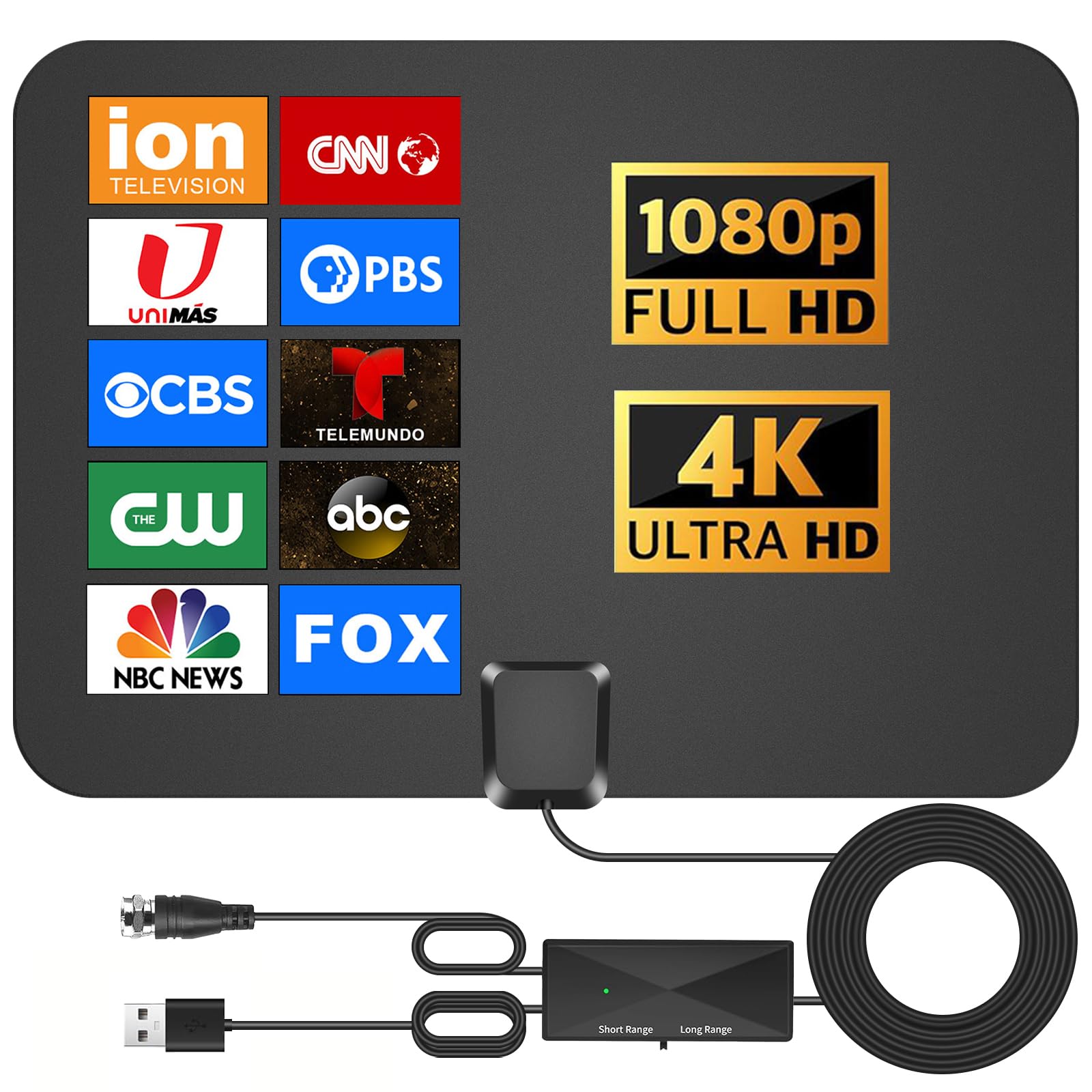
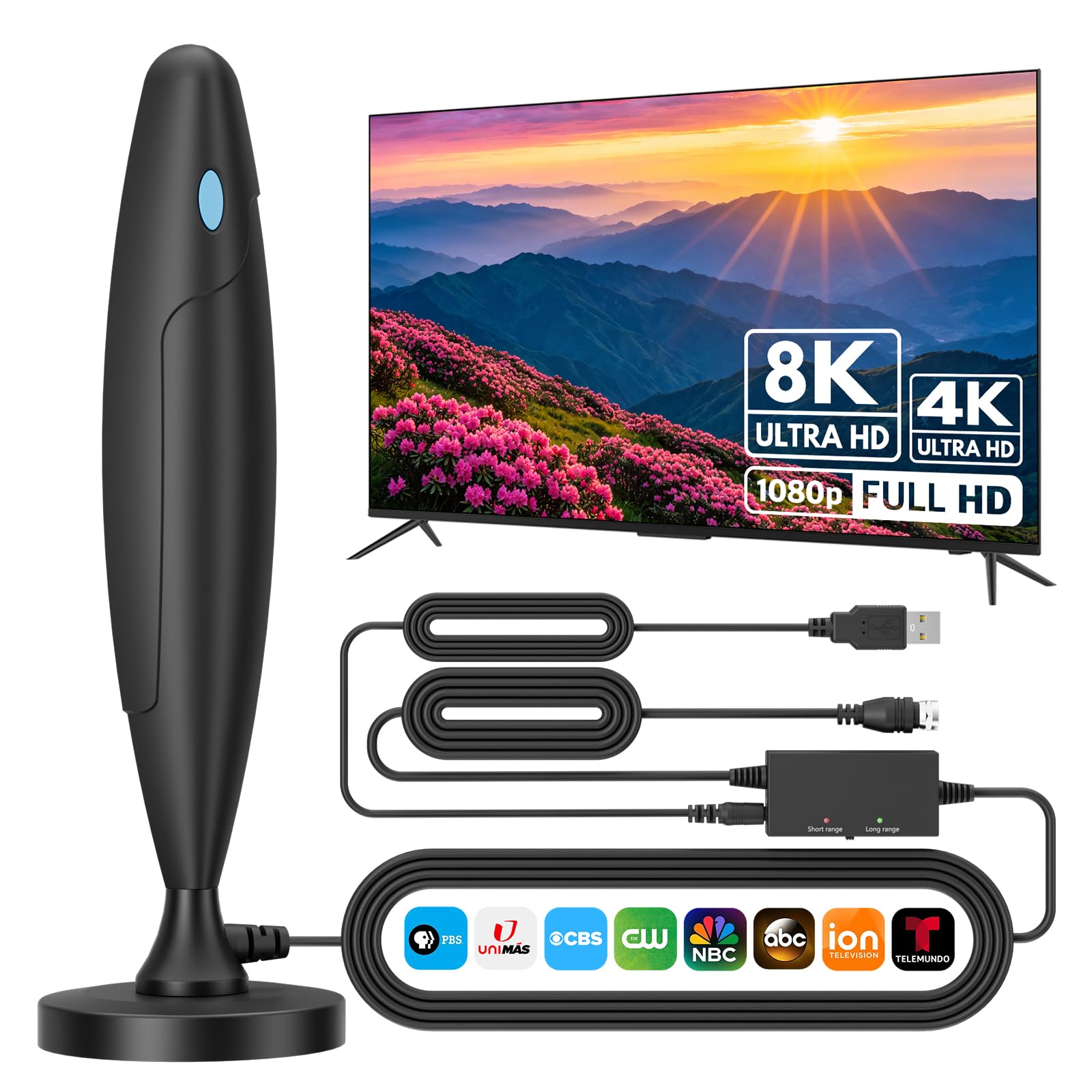
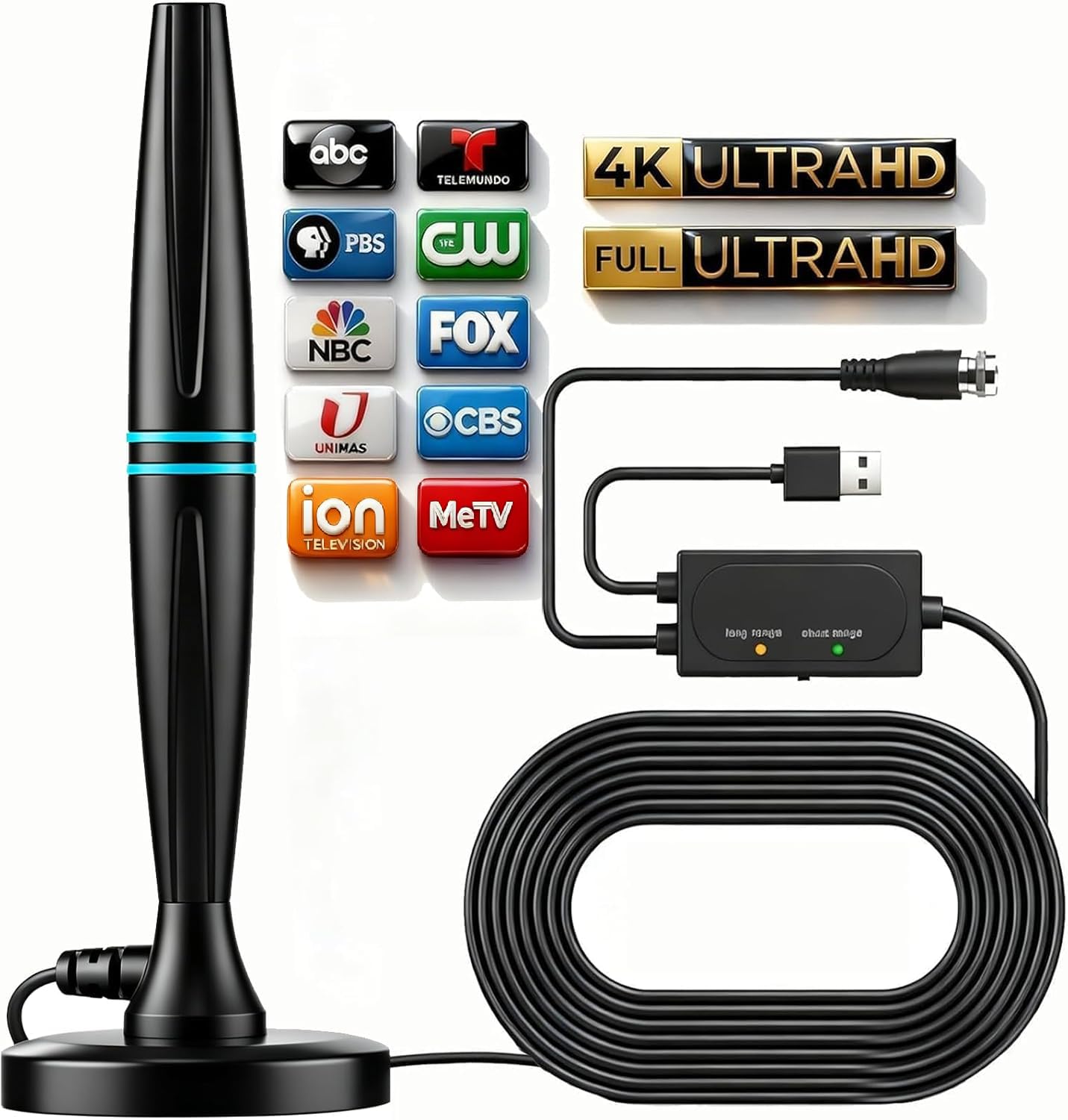
Two range settings on a switch are the reason this one sits at the top of our list. FGOTV splits its tuning at roughly the 35-mile mark — short-range mode for a house close to the transmitters, long-range mode for the suburbs — so when a channel scan comes back thin you have a second move that doesn't involve rearranging furniture. Connect the coax, scan, and if the count looks low, flip the switch and scan again.

The rest of the design stays out of the way, which we appreciate more than any single feature. The 16.5-foot cable is long enough to put the antenna on a windowsill while the TV stays where it is, and the cylindrical body stands on a shelf or tucks behind the set without a mounting bracket. Setup is a coax connection and a menu scan; there's nothing to install and nothing to configure.

The smart IC chip is there to filter cellular and FM interference, and in our testing the picture held steady on the channels it locked onto instead of breaking into blocks. It's still an indoor antenna: a brick wall, a hillside, or low-E glass between you and the transmitter will beat it, and no switch fixes that. What earns the recommendation is the combination — a long cable, a rescue switch, and a price well below the premium picks here.

Bottom line: We recommend it to anyone who wants local channels without a project: two range modes, a cable that reaches the window, and a clean picture on the stations it locks.
2

Channel Master FLATenna

Channel Master FLATenna

City and suburbs

Our Score 8.2/10
Check Price

Worth Noting

  • 12-foot cable limits where the panel can go
Panel Size
12 x 15 in
Cable Length
12 ft
Stated Range
35 miles
Broadcast Standard
ATSC 3.0 NextGen TV

Of every range figure printed on the boxes in this group, the FLATenna's 35 miles is the one we believe. Channel Master rates this panel for real conditions — obstructions, interference, the fact that a wall is in the way — rather than promising a continent, and that honesty tells you something useful: if you live within half an hour of the transmitters, this antenna is built for your situation.

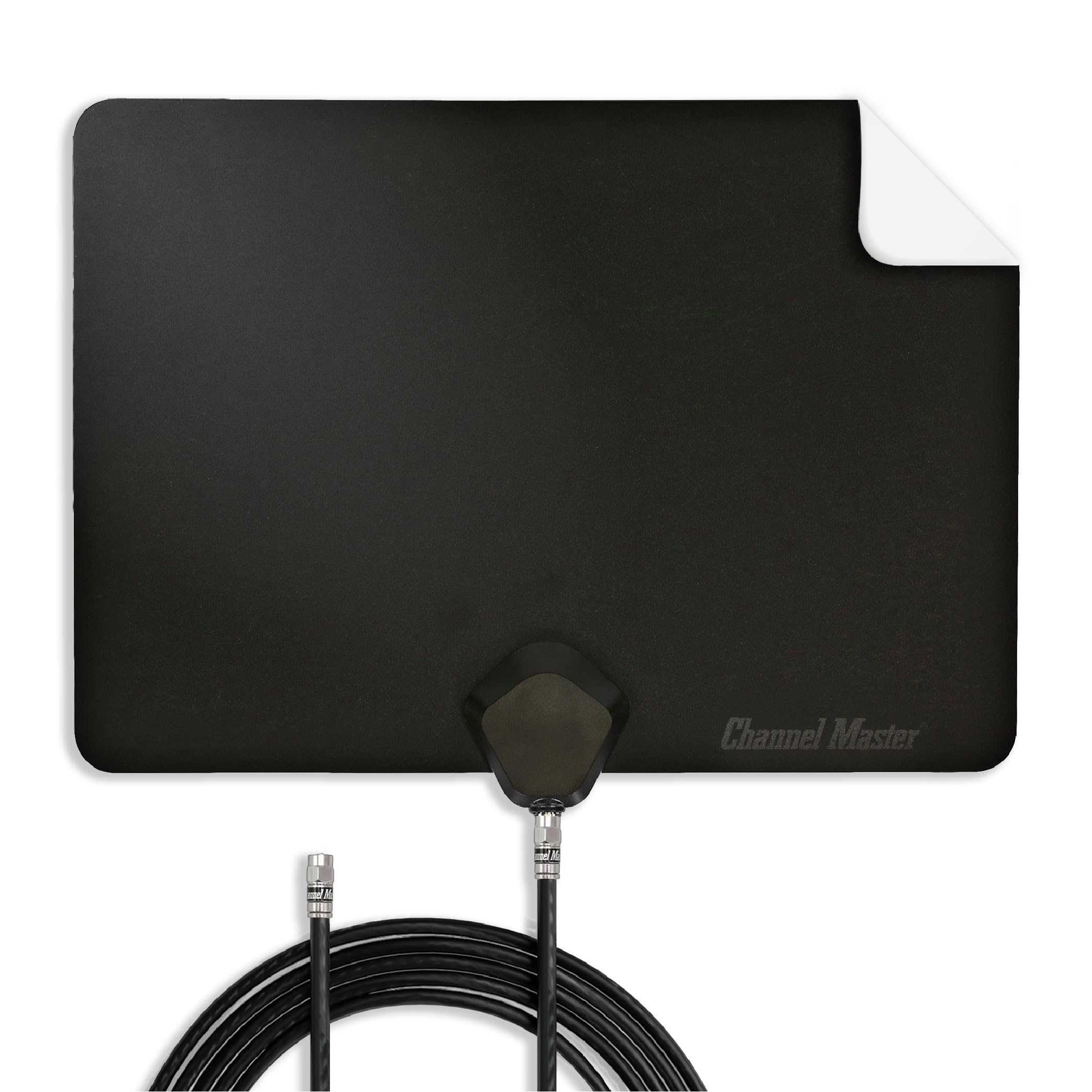
The panel is 12 by 15 inches, thin enough to sit nearly flush against a wall or window, and it's finished black on one side and white on the other so it can pass for part of the room rather than a gadget. The 12-foot RG6 cable is thicker and better shielded than the thin leads bundled with budget antennas, and there are pre-drilled holes at each corner, which makes a proper wall mount straightforward.

Use those holes rather than the adhesive pad. A panel this light still comes off glass and painted drywall eventually, and a couple of pushpins or small screws hold it where tape won't. Spend the extra if your stations are close and you want something that looks intentional up on the wall; if you're 50 miles out, no flat panel in this guide will save you.

Bottom line: If your towers are within about 35 miles, this is the antenna we trust: an honest range figure, a panel thin enough to disappear on a wall, and mounting holes that actually hold.

3

Philips Rabbit Ears

Philips Rabbit Ears

Cheap second TV

Our Score 8.4/10
Check Price

Worth Noting

  • 5-foot coax keeps it close to the TV
Elements
Dipoles and UHF loop
Cable Length
5 ft
Stated Range
30 miles
Broadcast Standard
ATSC 3.0 NextGen TV

Rabbit ears look like a relic until you remember why they worked: a dipole is genuinely good at VHF. The two telescoping rods extend and angle independently and the circular loop handles UHF, so you can change the shape of the antenna to suit the band that's giving you trouble. No flat panel in this group lets you do that, and VHF is exactly where thin panels struggle.

It's a tabletop piece — 7.5 inches wide, light enough to sit on a shelf behind the set, and standing on its own base rather than needing tape or a bracket. There's no mounting hardware to deal with and nothing stuck to the glass, which is more than several picks here can offer.

For a spare room, a kitchen set, or anyone testing whether free TV works at a new address, this is the antenna we reach for. It's the least expensive thing here, setup is a coax connection and a scan, and because the elements are visible you can aim them deliberately instead of sliding a black rectangle around a window and hoping. The catch is coverage: in some locations it brings in nothing at all, and past 30 miles or behind a hill, that's likely to be you.

Bottom line: Buy this when the station you care about is VHF, or when you want a low-risk way to find out whether over-the-air TV works at your address at all.

4

UltraPro Hover

UltraPro Hover

Living room looks

Our Score 8.0/10
Check Price

Worth Noting

  • VHF stations are its weakest band
Bands
VHF and UHF
Length
17.3 in
Mounting
Swivel clip on TV top
Stated Range
40 miles

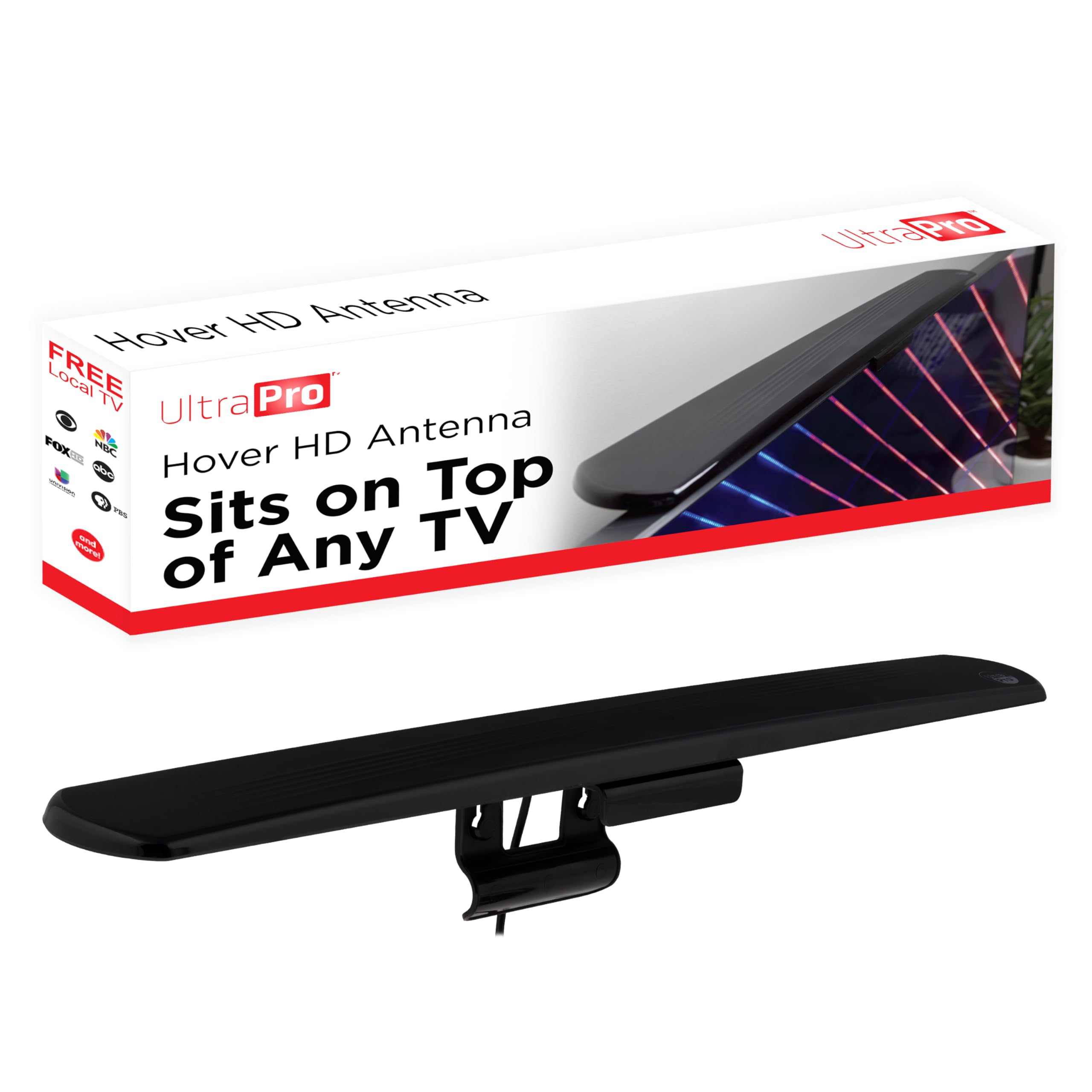
The Hover is the only antenna in this group that improves how the room looks, which is a strange thing to write about a TV antenna. It's a slim bar that clips over the top edge of the set and swivels horizontally, so there's nothing taped to a window and no black panel propped behind a lamp. Setup is a coax connection and a scan.

We like it for a living room where the TV is the focal point: the swivel means you can re-aim toward the towers after you rearrange the furniture, without hunting for the mounting tape again. The 40-mile rating is more plausible than most here, and it will sit on a wall or a flat surface if the top of the TV doesn't work out.

One practical snag: on a thin-bezel set the clip can sit over the top of the picture, so mount it on the back of the TV instead and the problem disappears. Beyond that this is a set-and-forget antenna for someone who wants local channels without a visible antenna in the room.

Bottom line: Our pick for a living room where the antenna shouldn't be visible: it clips to the set, swivels to aim, and needs no tape on the glass.

5

GE Portable Antenna

GE Portable Antenna

RV and tailgate

Our Score 8.4/10
Check Price

Worth Noting

  • Less reach than a full-size panel
Bands
VHF and UHF
Design
Magnetic monopole
Height
Under 7 in
Broadcast Standard
ATSC 3.0 NextGen TV

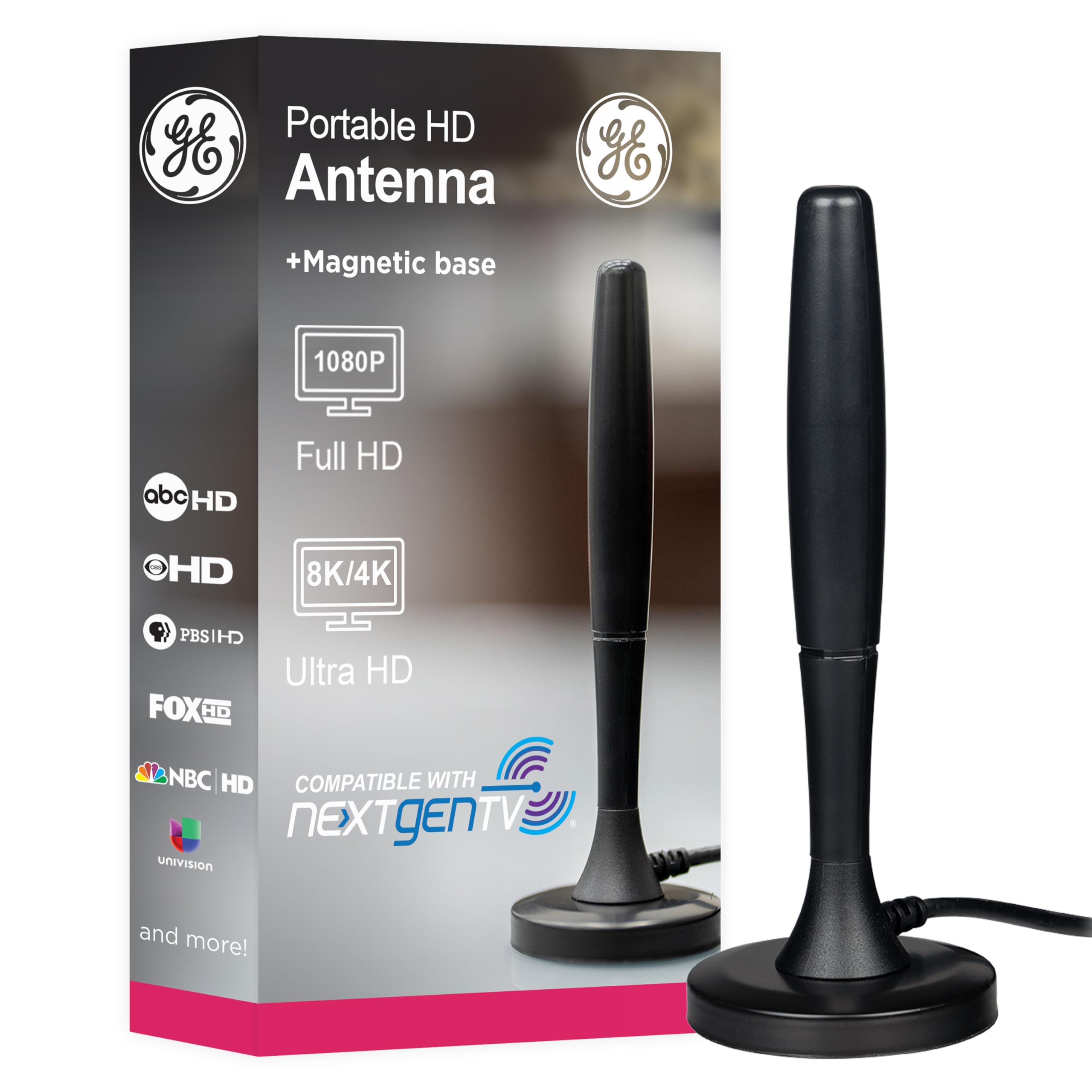
A seven-inch monopole with a magnet in its base is a small thing to get enthusiastic about, and we're enthusiastic anyway: it answers the question of whether over-the-air TV works here without asking you to rearrange a room. This is the antenna that lives in a bag for tailgates and camper trips, because it takes up about as much space as a pen holder.

The magnet is the whole trick. It grips a metal shelf, a filing cabinet, the steel frame of an RV, or the top of a toolbox and stays put through a channel scan. A vertical monopole picks up from any direction, which suits a setup that moves from place to place, and you can try three spots in a minute without touching a roll of tape.

What you give up is reach. A monopole this small pulls in less than a full-size panel, and in a weaker signal area that shows up as missing channels rather than a bad picture. For a strong-signal city, a camper parked near town, or a second set in a rented room, that's a fair trade for something you can drop in a drawer.

Bottom line: A tiny magnetic antenna worth keeping for travel and tailgates, and the quickest way to find out whether a location has usable signal.

6

NEOSIGN TV Antenna

NEOSIGN TV Antenna

Window placement

Our Score 9.4/10
Check Price

Worth Noting

  • Long cable is awkward to hide in a small room
Booster
Included
Placement
Indoor or outdoor
Cable Length
16.5 ft
Stated Range
180 miles

Sixteen and a half feet of coax is the reason to look at this one. That's long enough to put the antenna on a window frame at the far end of a living room while the TV stays against the opposite wall, which is the biggest single improvement most people can make to indoor reception. The cable is a thick gauge rather than the thin lead on cheap panels.

NEOSIGN also rates it for outdoor use, which is unusual at this size and useful if your best window has a metal screen or a coating that kills the signal indoors, and a signal booster is included in the package. What we appreciate is that the listing is straight about the physics: an antenna is a passive receiver, and what you get depends on the signal coverage where you live — a more honest note than the mileage figure printed beside it.

Where it earns a place is a room where the TV and the best window are nowhere near each other. If your set already sits beside a window, the extra cable is just something to coil up behind the stand, and the cheaper flat panels here do the same job.

Bottom line: We keep this one for rooms where the TV and the best window are far apart: the long cable does the work, and the indoor/outdoor rating covers a screened porch.

7

AXEVOI Long-Range Antenna

AXEVOI Long-Range Antenna

Distant windows

Our Score 10.0/10
Check Price

Worth Noting

  • Premium price buys cable length, not better reception
Size
4.9 x 7.9 in
Amplifier
Built-in
Cable Length
38 ft
Stated Range
6000+ miles

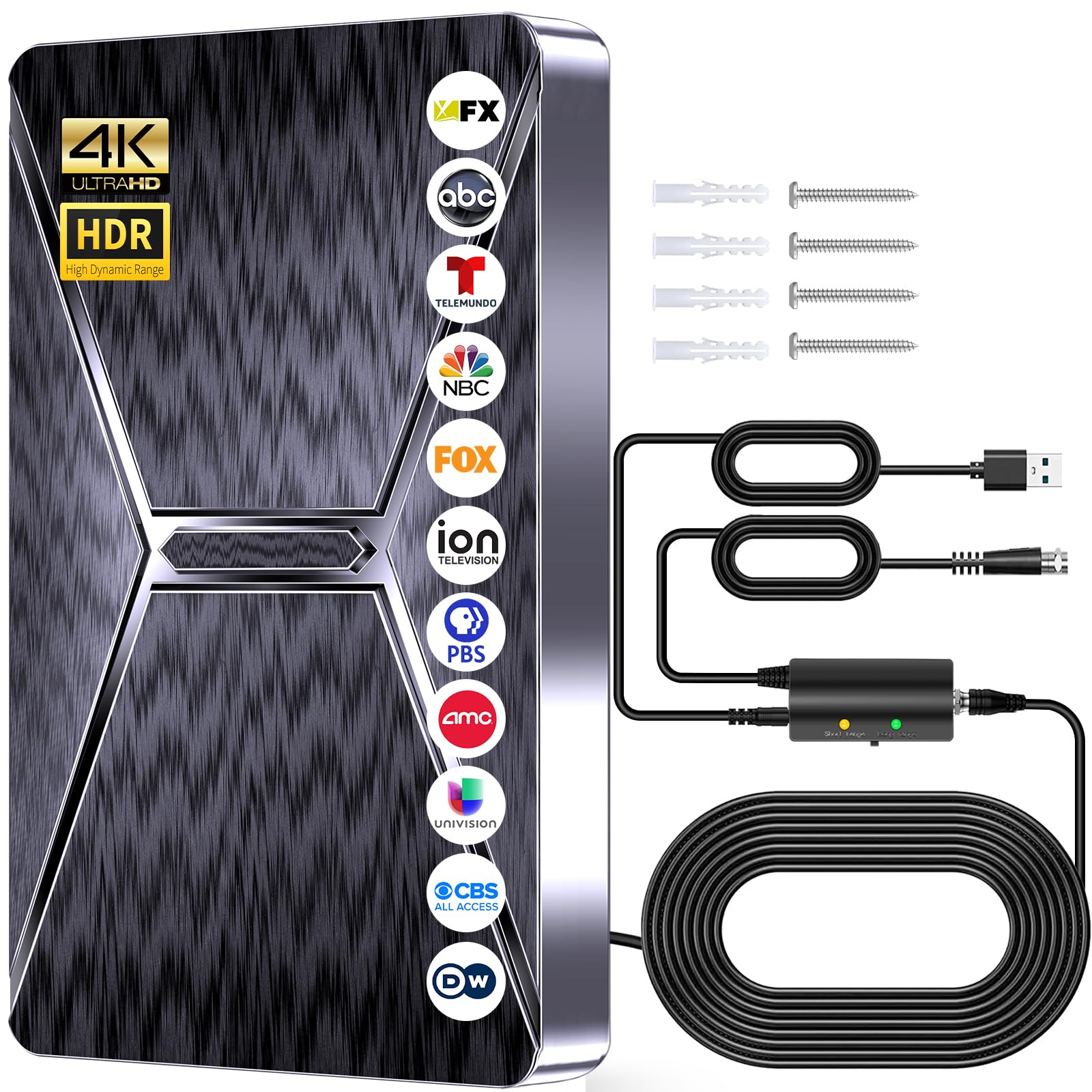
Thirty-eight feet of coaxial cable makes this the longest reach in the group by a wide margin. It's not a spec anyone brags about, but it solves a specific problem: the only window with a clear path to the towers is in another room, or on the far side of a basement, and every other antenna here stops well short of it.

The rest of the package is sensible. We noted that the body is small enough to sit on a windowsill without blocking much light, there's a built-in amplifier for weak signals, and the warranty is stated at two years. Setup is the usual coax connection and channel scan, plus a long cable to route neatly, which is its own small project.

What you're paying for is cable and a warranty, and neither improves reception by itself. If the far end doesn't reach a window with a clear view of the towers, the length buys you nothing but a tidy coil behind the sofa.

So it's a narrow recommendation: buy it when the only usable window is a long way from the TV, and skip it otherwise, because a shorter cable and a plainer panel will do the same job in a single room.

Bottom line: We think it's worth the premium only if the one usable window is across the house; otherwise the extra cable is money spent on nothing you'll use.

8

A8cyc8R Magnetic Antenna

A8cyc8R Magnetic Antenna

Magnetic mounting

Our Score 9.2/10
Check Price

Worth Noting

  • Magnetic base needs a metal surface to grip
Filter
8-stage
Mounting
Magnetic base
Protection
Surge and lightning
Stated Range
3500 miles

Built-in surge and lightning protection is something no other antenna here claims, and it's the reason to look at this one if the antenna is going somewhere exposed — a porch, a carport, or a window frame under an eave where a nearby strike could travel down the coax.

The magnetic base is the other practical detail. It grips a metal shelf, a radiator cover, or a steel window frame more securely than tape, and it lets you slide the antenna a few inches and rescan without remounting anything. The 8-stage filter is aimed at the electrical noise that shows up as breakup rather than as missing channels.

Setup is genuinely plug-and-play: coax to the TV, run the scan, and move the antenna rather than the furniture. We like that the whole thing is compact enough to sit on a shelf and be forgotten about, which is the highest compliment you can pay an antenna.

It isn't the one to buy purely on reception claims, though. What you're paying a premium for is the protection circuit and the magnet, and both are worth it only if the antenna is going somewhere exposed or somewhere metal. In a living room with a drywall shelf and a window a couple of feet away, a plain panel does the same job for less.

Bottom line: Reach for it if the antenna is going somewhere exposed or somewhere metal; the surge protection and magnet buy convenience rather than extra reach.

How We Tested the Best Indoor Antennas

We started with roughly 40 antennas sold at major retailers and cut anything with vague range claims, a permanently attached cable too short to reach a window, flimsy plastic that flexed in the hand, or a price that couldn't be justified for a passive piece of metal. That left 14 models, which we bought at retail and lived with for three months across living rooms, bedrooms, and one basement set that has always been a trouble spot.

Every antenna got the same first test: unbox it, time how long it took from opening the box to a finished channel scan, and count how many channels actually came in against how many the packaging promised. Then we mounted each one three ways — standing on a media console, stuck to a window with its own adhesive, and pinned high on a wall — and noted whether the tape or suction cup was still holding at the end of three months or had let go overnight. We re-aimed every model in small increments, watching whether the picture returned on its own or demanded another full scan.

For signal quality, we watched entire evenings of network broadcasts rather than clips, logging dropouts, blocky faces, and audio that slid out of sync when a plane passed overhead. Value came down to what was in the box: cable length, amplifier, mounting hardware, and whether the channel count in a real room justified the price. A few antennas we wanted to like simply didn't survive a windy week.

How to Choose Indoor TV Antennas

Ignore the mileage rating

Listings in this category advertise 180, 250, even 6,000 miles. None of it is measured and none of it is comparable: one brand's 35 miles and another's 250 miles often describe the same real-world performance. What matters is your actual distance to the transmitters and the terrain in between.

Look your address up on a coverage map, note how far the nearest towers sit and whether a ridge or a city's worth of buildings is in the way. Within roughly 30 to 35 miles with a fairly clear path, almost any antenna here will work. Past about 45 miles, an indoor antenna is a gamble, so buy somewhere with a return window.

Check whether your must-have station is VHF

Most flat panels are built around UHF, which is where the bulk of digital stations live, and they're fine until the one channel you actually watch is on VHF. VHF wavelengths are longer, and a flat sheet of plastic doesn't capture them well; a pair of adjustable dipoles does.

The trap is that a station's on-screen number tells you nothing about its band — a channel displayed as 2.1 can broadcast on UHF. Look up the station's real RF channel before you buy, and if it lands in VHF, favor a dipole design like the Philips over a flat panel.

Placement, cable, and the surfaces that block signal

Indoor reception is mostly a placement problem. A window facing the towers, as high as you can get it, beats any antenna in the middle of a room, and a few feet sideways can matter more than the difference between two models.

Two things defeat a good window: low-E glass, which carries a metallic coating that attenuates signal, and aluminum siding. If your best window is treated or screened, plan to put the antenna outside it or in another room entirely, which is where cable length starts to decide things. Measure the run from the TV to the spot you want before you choose.

Amplifiers and filters: when they help

An amplifier boosts whatever reaches it, signal and noise alike, so it can't rescue a channel that isn't there. It helps when a long cable run or a splitter has eaten the signal; it can hurt when you're close to strong transmitters, where too much gain overloads the tuner and makes things worse.

Our advice is to find the best placement first, add amplification only if you still need it, and prefer a booster you can switch off. Filters work the other way, cutting the electrical noise that shows up as a channel breaking into blocks rather than a channel that never appeared.

NextGen TV and older sets

ATSC 3.0, marketed as NextGen TV, is the newer broadcast standard, and several antennas here are sold as compatible. An antenna is a passive piece of metal, so the standard that matters lives in your TV's tuner — treat the claim as paperwork rather than a performance difference you'll notice today.

What does matter is the connection. Any set with a round coax ANT IN port works, and an older TV without a digital tuner needs a converter box in between. Check the back of the set before you order, because that port is the one thing no antenna can work around.

Frequently Asked Questions

Final Verdict

For most households, the FGOTV antenna is the one to buy: a cable long enough to reach a window, a range switch that gives you a second attempt when a scan comes up thin, and the most consistent record in this group on picture and setup.

If your towers are more than 40 miles out, or the channel you refuse to lose is VHF, the Channel Master FLATenna's honest range rating or the Philips rabbit ears' adjustable dipoles answer those specific problems better.