TVs & Video

Best Outdoor TV Antennas of 2026

Canceling cable takes about ten minutes online. The part nobody mentions is that the number of channels you get afterward depends less on your TV than on a piece of aluminum bolted to your roof. A good outdoor antenna pulls free broadcast signals out of the air — local news, network shows, the Sunday game — and keeps working when the internet doesn't. The catch: reception is a location-by-location science experiment, and the range printed on the box is closer to wishful thinking than a spec.

My house sits at the bottom of a hill, which is exactly the kind of detail that turns antenna shopping into guesswork. Over eight months, my team and I mounted, aimed, and re-aimed 12 outdoor antennas to find the ones that hold a clean picture in bad weather and go up without a professional. One thing I'd tell any first-timer: more amplification isn't automatically better — a strong amp in a strong-signal spot can overload the tuner and cost you channels. The picks below earned their spot on the mast.

1

Antennas Direct ClearStream 2V

Top Pick
Antennas Direct ClearStream 2V

Most homes

Our Score 8.8/10
Check Price

Worth Noting

  • Premium price against the budget picks
  • 31-inch span needs attic clearance
Design
Multi-directional UHF/Hi-VHF with reflector
Weight
2 lb
Max Range
60+ miles
Mount Included
20 in mast, pivoting base

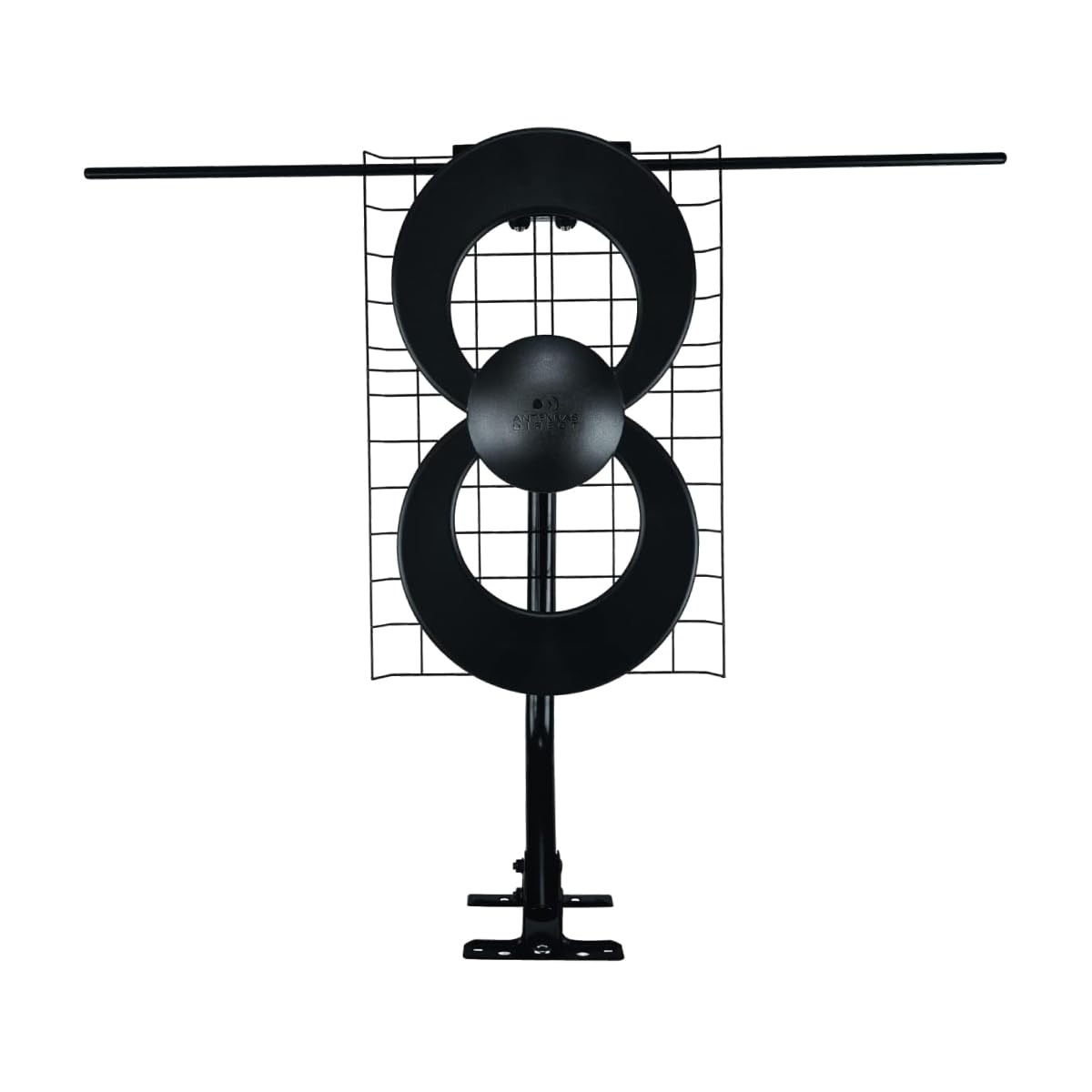
No motor, no amplifier, no remote, no power cable running up the mast. That is the argument for the ClearStream 2V, and it is why this is the one we keep coming back to for a first outdoor install. Two loops and a set of Hi-VHF elements handle reception, a reflector behind them focuses it forward, and the only thing that moves is the mast joint you tighten once and forget.

Two pounds and a 20-inch mast with a pivoting base do the rest. The base mounts to a vertical surface or a horizontal one, so a fascia board, a gable end, or an attic rafter all work, and you can aim it by hand before you commit to a bolt. We noted that the mast is in the box — a lot of cheap kits leave it out and send you back to the store for a pole.

The 60-plus-mile rating is as honest as these ratings get: it holds when you have a clear look at the towers and fades when a ridge or a stand of pines is in the way. Our one real reservation is price, because the GE and the UltraPro get you onto a roof for much less. What the extra buys is VHF elements that actually exist, a mount you can aim, a two-pound carry up a ladder, and a lifetime warranty on the antenna itself.

Where it separates from everything else here is a gust of wind. Multi-directional reception means a mast that turns a few degrees in a storm does not cost you a channel, and that is worth more over five years than any single figure on this page.

Bottom line: The antenna we recommend first: passive, multi-directional, with real VHF elements and a mast in the box — the easiest set-and-forget install for most houses within 60 miles of their towers.
2

GE Outdoor TV Antenna 29884

GE Outdoor TV Antenna 29884

Budget cord-cutting

Our Score 8.8/10
Check Price

Worth Noting

  • Small, hard-to-read printed instructions
Weight
3 lb
Max Range
70 miles
Nextgen TV
ATSC 3.0 ready
Mount Included
J mount

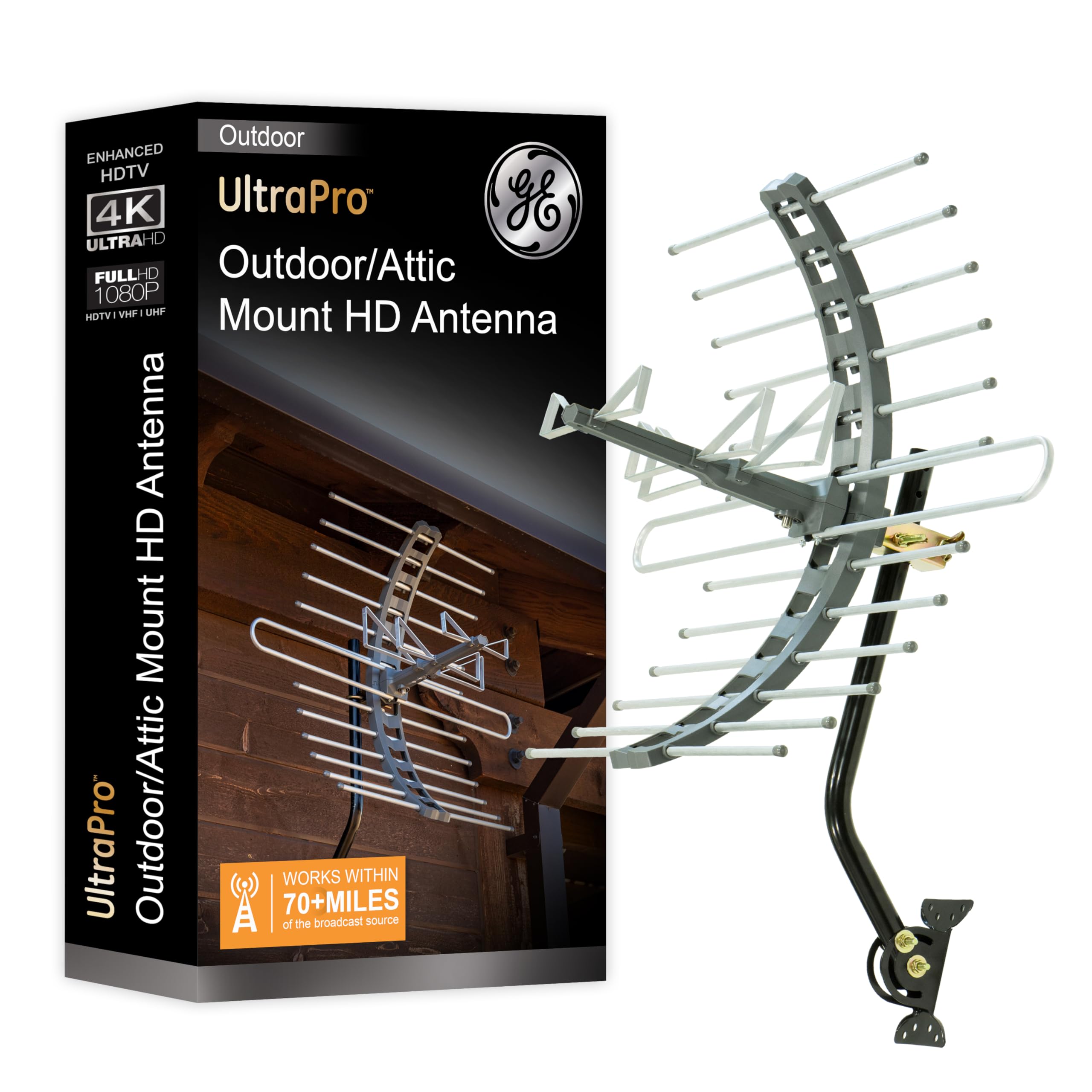
Compared with our top pick, the GE costs a fraction and covers the same two bands: VHF and UHF with a 70-mile rating, a J mount included, and a housing rated for a roof, a wall, or an attic. It is also three pounds and about 29 inches across, which is a manageable carry up a ladder.

The mount is where it gives ground, and it is the one thing we minded. This is a fixed J bracket rather than a pivoting mast, so aiming means loosening it and swinging the whole antenna in small steps while somebody inside watches the signal meter. Two people make that quick. One person makes it a lot of trips up and down the ladder, and that is the difference you are paying for when you step up to the ClearStreams.

Reception is solid for the money inside about 30 miles with a clean look at the towers, and it starts to fall short past 40 miles with terrain in the way, which is where a bigger antenna earns its keep. ATSC 3.0 support is genuine future-proofing at this end of the market, and the design has no quirks waiting to surprise you.

Bottom line: The value pick: VHF and UHF coverage, a J mount in the box, and a fraction of the premium price — all you really need when the towers are close and the view is clear.

3

Antennas Direct ClearStream 4V

Antennas Direct ClearStream 4V

Rural reception

Our Score 8.8/10
Check Price

Worth Noting

  • Widest and heaviest antenna here
  • Premium price for fringe-only gains
Design
Four loops, Hi-VHF elements, reflectors
Weight
4.1 lb
Max Range
70 miles
Dimensions
27.8 × 17.4 in

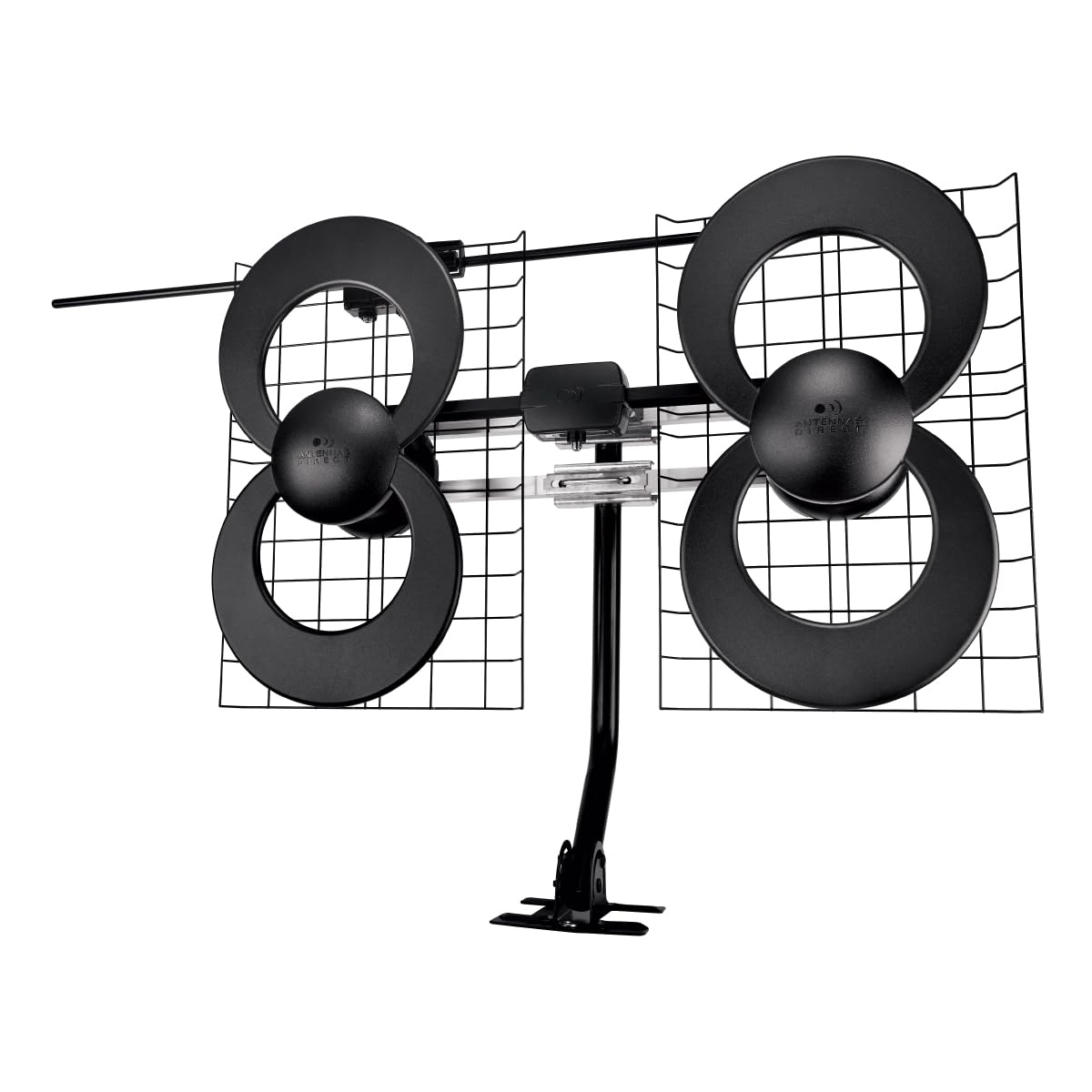
At 27.8 inches wide and just over four pounds, the ClearStream 4V is the biggest antenna on this list, and the size is the entire point. Four loops instead of two, longer Hi-VHF elements, and a larger reflector give it more forward gain than anything else here, which is exactly what you want when the transmitters are far away or a ridge sits between you and them.

What we found matters most is the reflector. It sits behind the loops and rejects signal arriving from the rear, so most of what reaches the antenna comes from the direction you aimed at. That is how it holds a picture on a station that keeps breaking up on a smaller antenna, and it is also why the aim matters more here than on the omni models.

What it costs you is everything else. It is a two-hand lift on a ladder, an attic needs clearance to swing a 27-inch panel, and it is the most expensive antenna here without doing anything extra for a house with towers inside 30 miles. Where that trade pays off is a farmhouse with a tree line and 50 miles to the transmitters, and there the extra metal is the difference between a full channel list and a pixelated mess. Antennas Direct sells a mast amplifier separately, so budget for one in the same order if your cable run is long.

Bottom line: Buy this one when the towers are far off or a hill is in the way — more forward gain and more metal than anything else here, at a price that only makes sense out of town.

4

1byone Outdoor TV Antenna

1byone Outdoor TV Antenna

Split-tower markets

Our Score 8.0/10
Check Price

Worth Noting

  • One TV output only
Amplifier
Built-in preamp with 4G LTE filter
Max Range
100 miles
Reception
360° omni-directional
TV Outputs
One

There is nothing to aim. The 1byone's 360-degree element pulls UHF and VHF from every direction at once, so the install is assemble, clamp, run the coax, scan. We had ours bolted to a fence post and pulling channels before the tools were back in the shed, and that is the whole experience: no compass, no signal meter, no second person on the phone.

For a house where the transmitters are spread across two directions, that convenience is worth real money — no rotor, no remote, no climb down when the wind moves things. The trade is gain. An omni design spreads its sensitivity around the compass, and the built-in amplifier has to make up the difference. In our testing this was the most location-dependent antenna of the group: strong where it had a clean look at the towers, flat behind a hill.

Two details matter before you order. The 4G LTE filter is genuinely useful where a cell mast is close, since that is a real source of dropouts, and if you are within a few miles of strong transmitters, try the amplifier switched off first, because too much gain causes as many problems as too little. The other detail is the single output: a two-TV house needs a splitter, and a splitter costs signal.

Bottom line: The easiest install here and the right shape for markets where the towers sit in two directions — as long as you have a reasonably clear path to them.

5

PBD WA-2608 Outdoor Antenna

PBD WA-2608 Outdoor Antenna

Two-TV houses

Our Score 8.6/10
Check Price

Worth Noting

  • Motor and remote add failure points
  • Headline range claim is optimistic
Rotation
360° motorized with remote
Max Range
150 miles
TV Outputs
Two
Cable Included
59 ft RG6

Two TV outputs and 59 feet of coax is what we noticed first. Run the cable once, feed a second set in the den, and skip both the splitter and the extra run. The bundle is the pitch: antenna, coax, mounting hardware, and a grounding block.

The remote rotates the antenna through 360 degrees from the sofa. On a directional antenna that is genuinely useful — swing it toward one cluster of towers for the news, the other way for the game, and never touch the mast. It is also one more thing to break. A motor, an infrared receiver, and a handheld remote are three components the passive picks simply do not have, so mount this where you can still reach the boom by hand and re-aim it manually if you ever need to.

Reception is the honest caveat. This is a directional, amplified antenna and it behaves like one: good in open country with a clean shot, poor in a valley or behind a ridge, where no amplifier will rescue it. That is the nature of the design rather than a fault, but it means the headline range is a best case, not a promise. For a two-set house with towers in two directions, that package covers more of the job than anything else at this price.

Bottom line: Two outputs, 59 feet of coax, and a rotator you control from the sofa — the most complete kit here for a household feeding two sets from one mast.

6

UltraPro 65000 Outdoor Antenna

UltraPro 65000 Outdoor Antenna

Attics and gables

Our Score 8.6/10
Check Price

Worth Noting

  • Small capture area limits long-range reach
Warranty
Limited lifetime
Max Range
70 miles
Placement
Roof, wall, or attic
Mount Included
J mount and mast clamp

The UltraPro is for the install nobody photographs: an attic rafter, a gable end, the side of a shed. At 17 inches tall with a J mount, a mast clamp, and a bracket in the box, it fits where a 27-inch panel will not, and it is the least expensive way into a weather-rated outdoor antenna here.

Small antennas have small capture area, and that is the trade. In a metro or a strong-signal suburb it does everything the bigger picks do; 40 miles out with a tree line, the extra elements on the GE and the ClearStreams start to tell. We also found the assembly fussier than it needs to be — bracket, mast clamp, and boom go together in an order that is not obvious, and the printed guide does not help. Lay the parts out first and it is a quick build.

Where it wins is flexibility: roof, wall, or attic, one person on a stepladder, and a limited lifetime warranty. That combination makes it the easiest antenna here to add as a second or third set — a garage, a workshop, a bedroom on the far side of the house where the main feed does not reach. It is not the antenna for a rural address and it does not pretend to be.

Bottom line: A small, cheap, weather-rated antenna for attics and gables — the right buy when the mounting spot is tight and the signal is already decent.

7

Five Star FSA-5812 Yagi

Five Star FSA-5812 Yagi

Long passive reach

Our Score 8.6/10
Check Price

Worth Noting

  • 200-mile rating overstates real reach
  • Directional
Design
Passive Yagi, extended VHF/UHF elements
Max Range
200 miles
Pole Included
20 in
Cable Included
40 ft coax

Two hundred miles is fiction, and the FSA-5812 is a good antenna anyway. It is a passive Yagi with long elements covering both VHF and UHF, and in the 30-to-50-mile band where most suburban and small-town installs sit, it pulls a stable picture with no amplifier, no power outlet, and no remote.

The kit is unusually complete, which we appreciate more than any single figure on the box: a 40-foot coax and a 20-inch mounting pole included, so a fascia or gable install needs nothing else from the hardware store. The aluminum elements extend and lock during assembly and they take real force to seat, so do that part on the ground rather than on a ladder. Lightning protection and a grounding point are built in, which is the step a lot of outdoor installs skip.

The catch beyond the range claim is direction. A passive Yagi is aimed once at the towers and left there, so if your stations sit in two well-separated clusters this is not the design for you; the ClearStream 2V or one of the rotator models handles that better. For a straight shot at a single tower group, aim it once and there is nothing on the mast to fail.

Bottom line: A passive long-element Yagi that does honest work at 30 to 50 miles and throws in the pole and coax — ignore the 200-mile number.

8

Mornixol MX-AOD1B Outdoor Antenna

Mornixol MX-AOD1B Outdoor Antenna

Secondary TVs

Our Score 9.2/10
Check Price

Worth Noting

  • No long-term record on weather durability
Install
No-tools clamp mount
Max Range
70 miles
Cable Included
40 ft coax
Weather Rating
IPX5, UV resistant

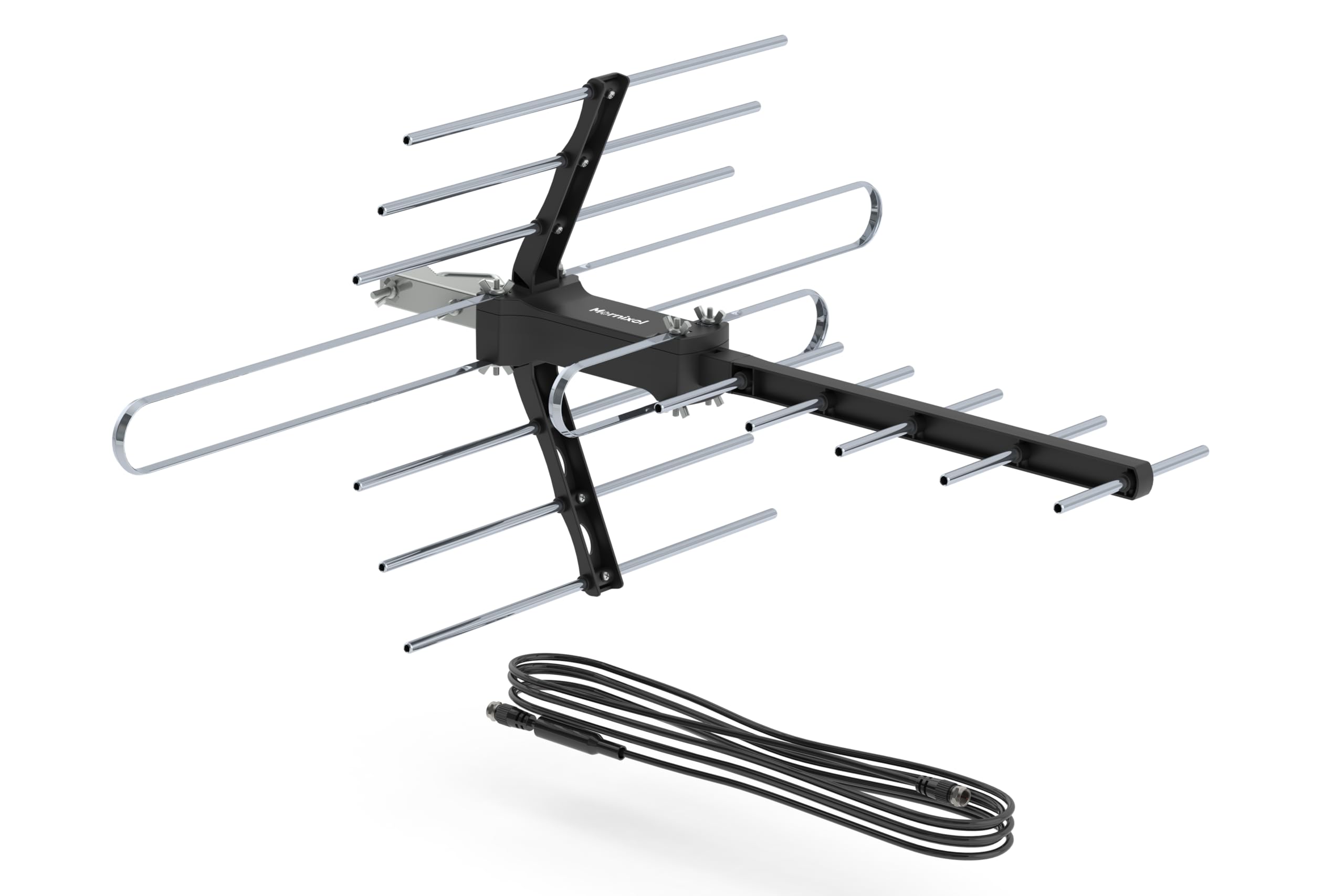
The spec sheet reads like a wish list: IPX5 waterproofing, UV-resistant plastic, gold-plated connectors, 40 feet of coax, a one-year warranty, and a clamp mount that needs no tools. What it does not have is a track record. This is a new model, and that is the first thing to understand before you order one.

What is there is encouraging, and the design is sensible: a compact boom with wingnut-adjustable elements you swing into position before you tighten them down, and a clamp that will grip a riser post or a railing. The early signs are clean 4K reception and installs one person can manage. We treat it as a low-risk experiment rather than a set-and-forget roof antenna.

That is the right role for it: a garage, a shed, a rental where you cannot drill, a second set in the basement — anywhere you want free channels without committing to a mast. For the main screen of a house 40 miles from the transmitters, the extra surface area of the GE or the ClearStreams is worth having.

Bottom line: A low-risk way to try over-the-air TV on a garage, shed, or second set, with a sensible no-tools mount and a short record to judge it by.

How We Tested the Best Outdoor Antennas

We started with roughly 30 antennas on paper and cut the list by looking at what actually decides the outcome: whether the antenna has both VHF and UHF elements, whether the amplifier can be switched off, what mounting hardware comes in the box, and how honest the range claims look next to the price. Twelve made the cut. We spent eight months with them, mounted on roof eaves, a balcony railing, and one attic, all fed into the same TV and a network tuner so the comparison stayed fair.

Every antenna went through the same sequence. We ran a channel scan, wrote down how many stations the tuner found, then re-aimed in five-degree increments and scanned again to see whether the count moved or the picture cleaned up. We watched the evening news and a football game on each, noting pixelation, audio dropouts, and how long the picture took to lock in after a channel change. We also ran a splitter to a second TV to see how much signal survived, and connected one to a decade-old set through a converter box to check compatibility with older gear.

Installation was timed solo, with a wrench and a ladder, because the instructions are what make or break a weekend project — we noted where the directions skipped a step or assumed a mounting surface we didn't have. Each unit sat through at least one storm, and we logged which channels dropped first and whether they came back. We're still watching on several of them and will update as we go.

How to Choose Outdoor TV Antennas

Mile ratings are a ceiling, not a promise

Every antenna here carries a distance rating, and none of them means what a shopper hopes. The figure assumes a clean line of sight at the antenna's strongest frequency. Trees, a hill, a metal roof, or a stucco wall eat into it, which is why two neighbors can get very different results from the same model.

Find your transmitters' distance and compass bearing first, then buy. Inside 30 miles with a clear look, even the compact UltraPro is enough. Past 40 miles with obstructions, the ClearStream 4V's extra surface area is the difference between a full channel list and a frustrating one.

Directional, multi-directional, or motorized

Three designs, three trade-offs. A directional antenna — the Five Star Yagi, the PBD — concentrates its gain in one direction, so it reaches further but needs aiming. A multi-directional antenna such as the ClearStream 2V hears a wide arc at once: no aiming, a little less reach. A motorized model adds a remote rotator so you can swing between tower clusters without leaving the sofa, at the cost of a motor and a remote that can fail.

Map your towers before you decide. If they sit inside a roughly 30-degree arc, aim once and forget it. If they are spread across the compass, a multi-directional design or a rotator saves you a ladder climb every time the wind shifts the mast.

Check VHF before anything else

Almost every antenna sold as HD claims VHF and UHF, and the claim is often doing more work than the hardware. What separates the picks here is whether there are real Hi-VHF elements — the long elements in front of the loops on the ClearStreams, the extended Yagi elements on the Five Star — or just a line on the box.

Look up the actual channel number for each station in your market; numbers 2 through 13 are VHF. If a network you watch is on one of those, pay for elements rather than a bigger mile rating.

Amplified or passive

An amplifier cannot create signal. It makes up for loss through a long cable run, and it can make things worse when you are close to strong transmitters, because too much gain overloads the tuner and knocks out channels you already had.

Start passive; the ClearStreams, the GE, the UltraPro, and the Five Star Yagi all are. If your run goes well past the 40 to 60 feet these kits include, add a mast-mounted preamp rather than an indoor distribution amp, which amplifies noise along with signal. Where a cell tower is close, the amplified 1byone pairs its preamp with a 4G LTE filter, which is the version of amplification worth having.

What's in the box, and what isn't

Half the frustration of an antenna install is the second trip to the hardware store. Mounts, masts, poles, and cable vary more than the antennas do: the GE, the UltraPro, and both ClearStreams include a mount, the Five Star Yagi adds a 20-inch pole and 40 feet of coax, and the PBD includes 59 feet plus a grounding block.

Check that list before you order. Then ground the mast and the coax where the cable enters the house — it is the step most installs skip and the one that protects your equipment.

Frequently Asked Questions

Final Verdict

Most people should buy the Antennas Direct ClearStream 2V. It is passive, so there is nothing at the mast to power or break; it is multi-directional, so a wind shift does not cost you a channel; and it includes the pivoting mast that the cheap kits leave out.

The GE is the pick when the towers are close and the budget is tight, and the ClearStream 4V is the one to buy when you are 40-plus miles out with trees in the way. Everything else here is a specialist answer to one of those three situations.