Phone & Tablet Accessories

Best Power Bank with a Built-In Cable of 2026

The dead-phone panic almost always arrives at a bad moment — navigation running, 8 percent left, and the cable you were sure was in your bag is sitting in a drawer at home. A power bank with a built-in cable fixes one specific problem, but it happens to be the problem that actually strands people: the battery and the cord living in two different places. What a good one buys you is a single object you can grab on your way out the door. What a bad one costs you is a pocketful of dead weight that tops your phone up at a crawl and dangles by a cable that stops connecting within a month.

Over the past nine months my team and I have lived with 12 of these things, and the spread is wider than you'd expect. One thing worth knowing before you shop: printed capacity is measured at the internal cell's voltage, so what actually lands in your phone runs closer to two-thirds of the number on the box. A 10,000mAh bank is realistically one solid top-up plus a partial one, not the three charges the packaging implies. The picks below are the ones that earned a permanent spot in my bag.

1

HELLEE N18 15,000mAh

Top Pick
HELLEE N18 15,000mAh

Everyday carry

Our Score 8.8/10
Check Price

Worth Noting

  • Heavier than compact 10,000mAh packs
Weight
8.82 oz
Max Output
22.5W
Built-in Cables
4
Battery Capacity
15,000mAh

Most 10,000mAh packs with built-in cables are a day-long backup; the HELLEE N18 stretches that to a comfortable weekend. It carries 15,000mAh in a 250g body that measures 6 by 3.2 by 1.1 inches, so it sits between the pocket packs and the 20,000mAh bricks. Four built-in cables and six outputs mean you can leave the loose cords at home and still charge a phone, earbuds, and a tablet without playing musical ports.

What sold us is the balance. The 22.5W output is quick enough for a phone and reasonable for a small tablet, and the digital display takes the guesswork out of the last 20 percent. We also appreciate that the multi-cable design is genuinely useful rather than decorative: the cables stay attached, so the thing you need is always with the pack. It is not the lightest 10,000mAh option, and that is the point; the extra capacity is why it works as the default for most buyers.

The compromise is weight and size. At 250g it is heavier than a compact 10,000mAh pack, and it will feel like a small brick in a light jacket pocket. The 22.5W output is also phone-and-tablet territory rather than laptop territory. If you want the smallest possible travel kit, the AIFENG CP2 is easier to live with; if you want more headroom for a weekend, this is the one we reach for.

Bottom line: We think the HELLEE N18 is the pack most buyers should get: 15,000mAh, four built-in cables, and a 250g body that still fits a small bag.
2

AIFENG CP2 10,000mAh

AIFENG CP2 10,000mAh

Travel and hotels

Our Score 9.2/10
Check Price

Worth Noting

  • 10,000mAh is a one-day backup
Weight
7.05 oz
Recharge
Foldable AC plug
Built-in Cables
Integrated
Battery Capacity
10,000mAh

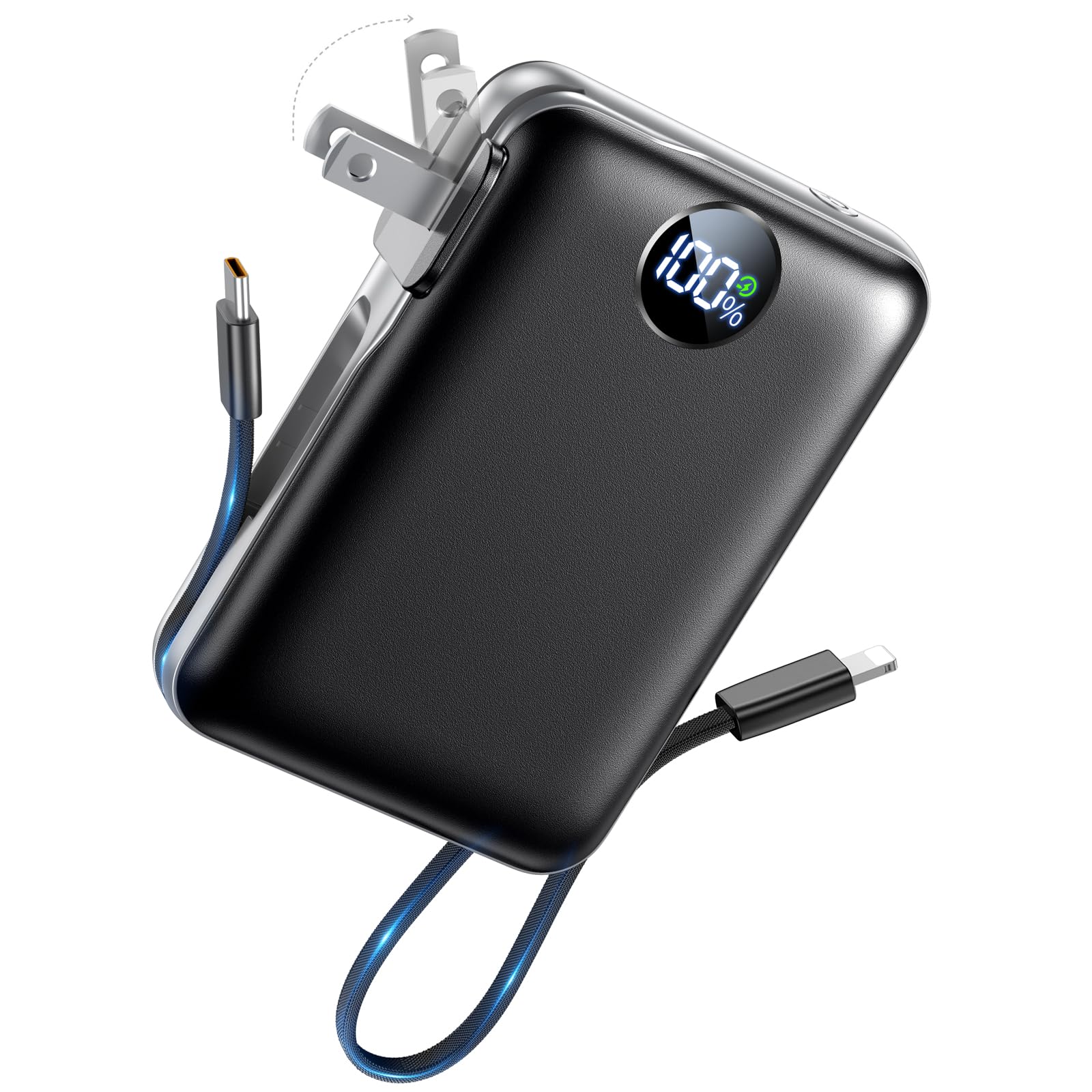
The foldable AC plug on the AIFENG CP2 is the detail that makes it a travel pack rather than just another 10,000mAh battery. You get built-in cables for your phone, a 22.5W output, and a 200g body that measures 3.66 by 2.36 by 1.26 inches. We like that the wall plug is part of the pack; in a hotel room or airport lounge, you can refill the bank without unpacking a USB-C cable.

The 10,000mAh capacity is a day pack, not a weekend pack. It will top up a phone a couple of times, handle earbuds, and maybe give a tablet a partial charge. The compact size is the real win: it disappears into a small sling or jacket pocket, and the built-in cables mean there is nothing loose to lose. We found the AC plug especially useful when traveling with one bag and limited outlet space.

The trade-off is capacity. It will not keep a power-hungry tablet going all day, and it will not replace a 20,000mAh pack on a long weekend. If you need multiple full phone charges or laptop power, move up to the HELLEE N18 or the UGREEN Nexode. For a travel bag where the pack itself must be easy to recharge, the AIFENG is the one we prefer.

Bottom line: We tell travelers to start here: the AIFENG CP2 combines built-in cables with a foldable AC plug, so the pack itself recharges without another cord.

3

Anker 20K 87W

Anker 20K 87W

Laptops and tablets

Our Score 9.0/10
Check Price

Worth Noting

  • Heavy at 15.2 ounces
  • Premium price for laptop-level power
Weight
15.2 oz
Max Output
87W
Built-in Cable
USB-C
Battery Capacity
20,000mAh

The Anker 20K 87W is the one we reach for when the device with the dead battery is a laptop, not a phone. It packs 20,000mAh, a built-in USB-C cable, and 87W of total output, with up to 65W going to a single device. That is enough to give a 14-inch MacBook Pro a meaningful top-up while a phone waits its turn.

The built-in cable is rated for more than 10,000 bends and stores against the body, so there is no dongle to forget. We appreciate the three-port layout: the built-in C cable, a USB-C port, and a USB-A port cover a laptop, phone, and a pair of earbuds without a hub. The 20,000mAh capacity is enough for several phone charges or a partial laptop charge, which is exactly what a travel pack needs to do.

The cost is weight and price. At 15.2 ounces, it is a bag pack, not something you forget in a pocket, and the premium over the 45W packs is real. We do not mind the weight when it replaces a laptop charger, but phone-only buyers are paying for output they will not use. If your heaviest device is a tablet, the UGREEN Nexode is the easier carry. If you routinely travel with a laptop, this is the one we keep in the laptop bag.

Bottom line: We keep the Anker 20K 87W for laptop days; 87W total and 65W to one device make it the strongest laptop option here.

4

UGREEN Nexode 20K

UGREEN Nexode 20K

Fast phone charging

Our Score 9.2/10
Check Price

Worth Noting

  • Heavy at 468g
Weight
1.03 lb
Max Output
45W
Built-in Cable
USB-C
Battery Capacity
20,000mAh

The UGREEN Nexode does most of what the pricier 20,000mAh packs do for less money, and that is why it stays in the bag. It combines a 20,000mAh battery, 45W output, a built-in USB-C cable, and a clear LED display in a body that measures 5.98 by 2.8 by 1.14 inches. We like that the built-in cable handles both charging and recharging, so one cable can top up a phone and then refill the bank.

Forty-five watts is enough for phones, tablets, and smaller laptops, though a large laptop will charge slowly. The display is genuinely useful; you can see the percentage instead of guessing from a row of dots. The pack is thick enough that it belongs in a backpack, not a jeans pocket. We found it a sensible everyday carry for someone who leaves the house with a phone and a tablet.

The main caveat is that the built-in cable is the part that will show wear first, and it is not user-replaceable. Treat the strain relief as the thing to check, and buy for the warranty rather than assuming it will last forever. If you need two built-in USB-C cables, the Anker Zolo 45W is the better fit; if you need laptop speed, the Anker 87W. For most phone-and-tablet buyers, this is the value pick.

Bottom line: The UGREEN Nexode is our value pick: 20,000mAh, 45W, and a built-in USB-C cable that handles charging and recharging.

5

Anker Zolo 20K 45W

Anker Zolo 20K 45W

Two USB-C devices

Our Score 9.2/10
Check Price

Worth Noting

  • Not a laptop-first pack
Weight
12.9 oz
Max Output
45W
Built-in Cables
2 × USB-C
Battery Capacity
20,000mAh

Two built-in USB-C cables is the reason to pick the Anker Zolo 45W over the other 20,000mAh packs here. It also has a USB-C port and a USB-A port, so four devices can share the 45W output, and the 20,000mAh battery is enough for a weekend of phone and tablet top-ups. The body is 4.72 by 2.89 by 1.24 inches and weighs 12.85 ounces.

The dual cables are more useful than they sound. One can feed a phone while the other handles a tablet or a friend's device, and you do not need to carry a spare cable to do it. We also like the digital display; it is easy to read at a glance. The 45W output is fine for phones and tablets, and the pack shares power across four devices without asking you to choose a port.

The main cost is weight. At 12.85 ounces, it is a bag pack, and the dual-cable hardware adds bulk compared with a single-cable design. If you only carry one phone, the UGREEN Nexode is lighter on the wallet and simpler. If two USB-C devices are normal for you, the Anker's second cable is worth the trade.

Bottom line: We like the Anker Zolo 45W for households or couples with two USB-C devices; the dual built-in cables are the feature that earns it a place.

6

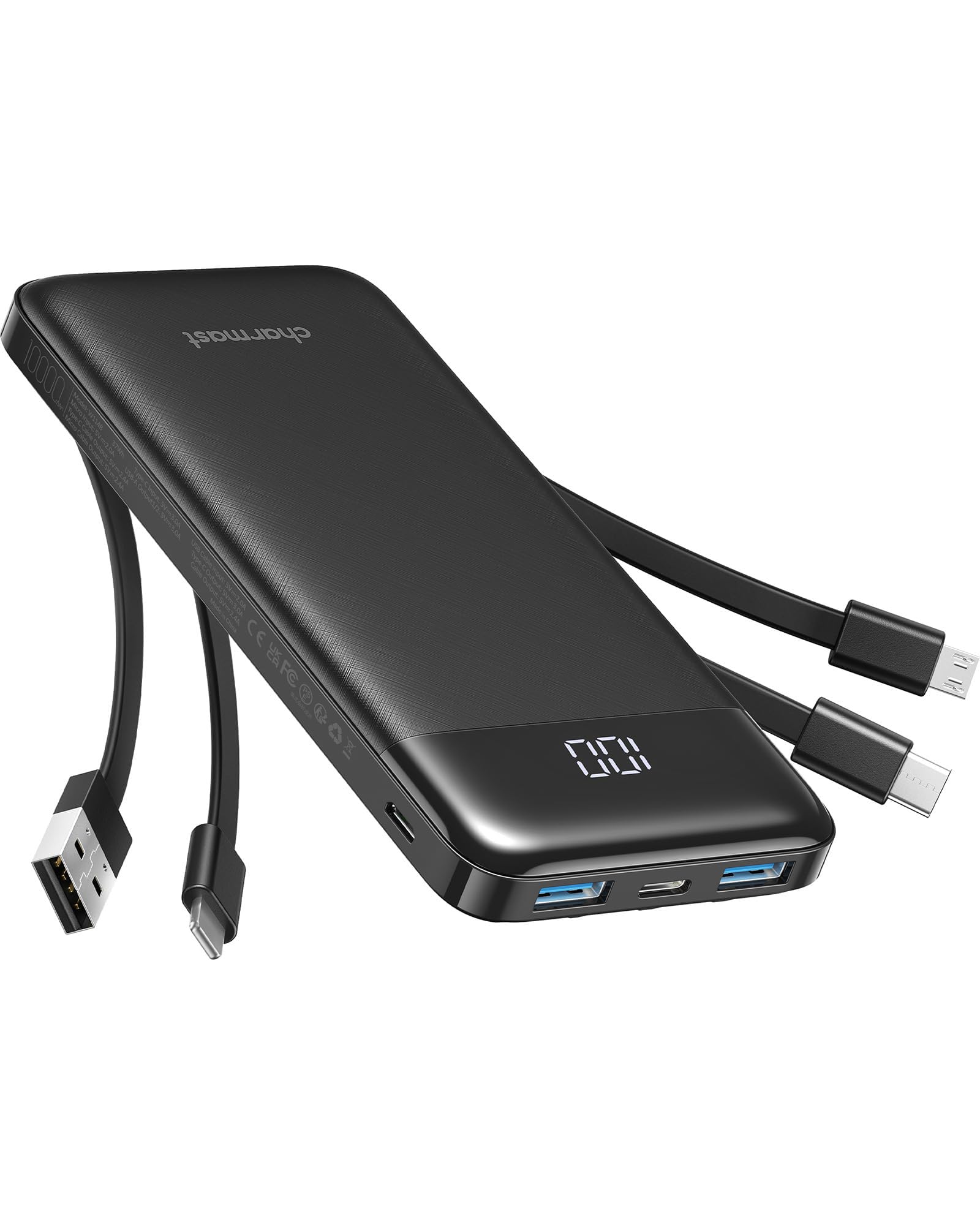
Charmast W1148 10,000mAh

Charmast W1148 10,000mAh

Budget cable variety

Our Score 8.8/10
Check Price

Worth Noting

  • Charging speed is modest
Weight
9.2 oz
Dimensions
5.67 x 2.64 x 0.71 in
Built-in Cables
4
Battery Capacity
10,000mAh

The Charmast W1148 is the pack we hand to someone who wants the cable variety without spending much. It has a 10,000mAh battery, four built-in cables, three ports, and a 3-year warranty, all in a body that measures 5.67 by 2.64 by 0.71 inches. Four built-in cables is a lot at this end of the range, and the storage bag is a small but welcome extra.

The slim body is the other reason it earns a look. At 0.71 inches thick and 9.2 ounces, it slips into a jeans pocket or a small bag more easily than the 20,000mAh packs here. The 10,000mAh capacity is a day pack: enough for a couple of phone top-ups and a pair of earbuds, not a weekend away. We like that the cables stay attached, so there is no loose cord to forget.

The 3-year warranty is unusual at this end of the range and welcome. The built-in cables are the main event, and the slim body makes it easy to keep in a bag. It is not trying to be a high-capacity pack; the point is having the right cable attached when you need a top-up.

We think the Charmast makes sense as a second pack, a glovebox backup, or a first power bank for someone who mostly needs convenience. If you need a pack that can handle a tablet all day, spend more on the HELLEE or UGREEN. For the money, the cable count and slim body are the story.

Bottom line: We see the Charmast W1148 as the budget pick for anyone who wants four built-in cables and a slim 10,000mAh body, provided speed is not the priority.

7

FancyBean M7 2-Pack

FancyBean M7 2-Pack

Two-car households

Our Score 8.6/10
Check Price

Worth Noting

  • Basic charging speed
Pack
2 power banks
Dimensions
5.83 x 2.68 x 0.63 in
Built-in Cables
2 per unit
Battery Capacity
10,000mAh each

Selling two 10,000mAh packs together changes the math: one can live in the car and one in a bag. The FancyBean set gives you two slim power banks, each with built-in cables and enough outputs to charge four devices at once. The black-and-white pair also makes it easy to tell whose pack is whose.

Each unit measures 5.83 by 2.68 by 0.63 inches, so it fits in a glovebox, purse, or backpack pocket without much fuss. The built-in cables are the same convenience as the single packs: no loose cord, no hunting for the right connector. The two-pack makes more sense than one higher-capacity pack when you want a spare that is already charged, not when you need the longest possible runtime from one battery.

We think the FancyBean pack is a smart buy for two cars, two people, or a parent who wants a spare. If you need one pack for a long trip, the HELLEE N18 or UGREEN Nexode is better. But for keeping one in each bag, the two-pack is the most practical package here.

Bottom line: For two cars or two people, we reach for the FancyBean two-pack; the second 10,000mAh pack is the spare you actually have charged.

8

SABANI N6 35,000mAh

SABANI N6 35,000mAh

Off-grid trips

Our Score 9.2/10
Check Price

Worth Noting

  • Above common 100Wh airline limit
Weight
11.3 oz
Max Output
22.5W
Built-in Cables
4
Battery Capacity
35,000mAh

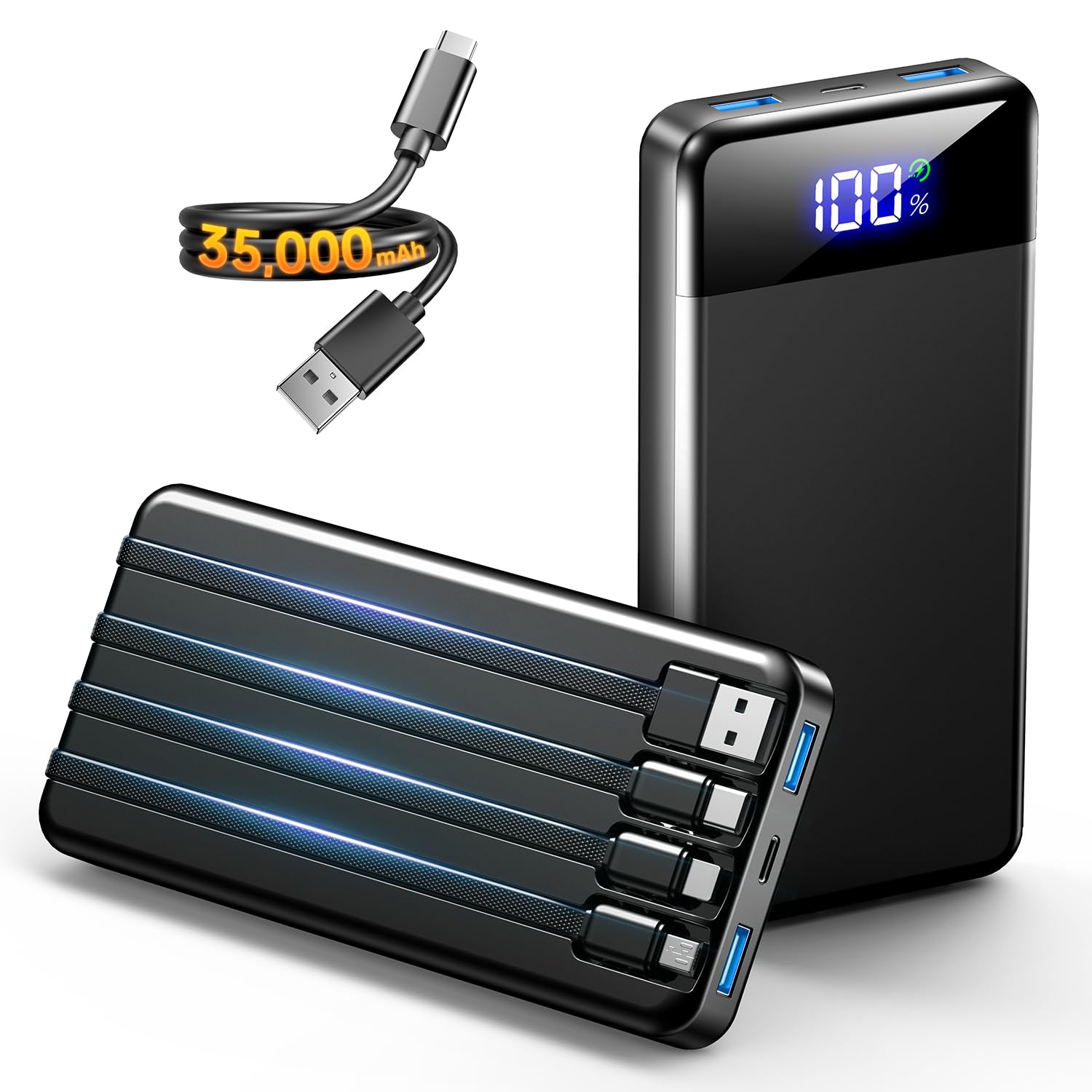
A 35,000mAh pack that weighs 320g sounds like a magic trick, and the SABANI N6 is best treated as a specialist rather than a daily carry. It has a 35,000mAh battery, four built-in cables, six outputs, and a 22.5W output, all in a body that measures 5.5 by 2.85 by 0.75 inches. The capacity is the point: it can keep a phone, tablet, and accessories going for days.

The built-in cables cover the common device types, and the digital display shows the remaining percentage. We like having the cables attached for a camping kit, where loose cords disappear into a tent pocket and never come back. The 22.5W output is fine for phones and tablets, but it is not a laptop pack; a larger device will charge slowly.

The catch is travel: this is a road-trip and campsite pack rather than a fly-anywhere battery, and it is heavier than the 15,000mAh HELLEE. That weight buys days of capacity, but it is not the pack for a daily commute. Check the airline rule before you plan to fly with it.

We think the SABANI earns a place for off-grid use, not as the one pack you carry every day. If you need a flight-friendly pack, choose a 20,000mAh model such as the UGREEN Nexode. If you need days of power at a campsite, this is the specialist we reach for.

Bottom line: Campers and road-trippers should look at the SABANI N6; we like its 35,000mAh capacity for off-grid days, not for flights.

What We Put These Power Banks Through

We started with roughly 40 models from brands we'd already used or that had a track record we could verify, then narrowed by the things that decide whether you'll actually carry one: connector type, stated capacity against price, and weight. Anything that needed a proprietary tip, shipped with only a single fixed connector, or padded its capacity claim without explaining the conversion got cut. That left 12 units, which we rotated through nine months of ordinary use.

Each bank went into a daily 40-minute train commute, a four-day camping trip with no outlet, a cross-country flight, and the bottom of a tote next to a set of keys. We timed charging a fully dead phone to 50 percent and then to full, noting the minutes and how warm the case got in the process, and we counted how many complete top-ups each one delivered before quitting. Every unit got weighed on a kitchen scale and checked against whether it cleared a front jeans pocket.

The built-in cable is the part that fails first, so we pulled each one out and pushed it back in hundreds of times, tugged at an angle while the phone was charging, and noted whether it locked into place or flopped loose. We dropped each bank from waist height onto concrete and re-ran the capacity test at the three- and six-month marks to see whether the numbers had drifted. Value came down to price per usable charge over that stretch, not the capacity printed on the shell.

How to Choose the Right Power Bank with a Built-In Cable

Match the built-in cable to your devices

The first thing to check is which connector is actually built into the pack. A USB-C cable is the versatile choice for modern phones, tablets, and smaller laptops; a Lightning cable is the one iPhone owners need. If your household mixes both, a four-cable pack such as the HELLEE N18 or Charmast W1148 saves you from carrying adapters. The built-in cable is only convenient if it fits the device you reach for most.

Do not assume every built-in cable can recharge the bank. Some packs use the built-in USB-C cable for both input and output, while others need a separate cable or a built-in AC plug. If you want a true one-cable kit, look for a pack that explicitly supports input through the integrated cable, like the UGREEN Nexode. If you want to leave charging cables at home entirely, the AIFENG CP2's foldable AC plug is the more radical solution.

Capacity and weight: choose the carry, not the number

Capacity is a trade against weight. A 10,000mAh pack is a day-long phone backup and the easiest to slip into a small bag; the AIFENG CP2 and Charmast W1148 sit in that class. A 15,000mAh pack like the HELLEE N18 adds roughly half a phone charge or more without becoming a brick. A 20,000mAh pack is the better choice for weekends, tablets, or laptop top-ups, but it belongs in a backpack.

The jump to 35,000mAh and 50,000mAh is a different purchase. Those packs are for camping, road trips, or power outages, and they are heavy enough that you will not want one in a pocket. Pick the smallest capacity that covers your longest regular day, then check the weight before you commit.

Output wattage: match the speed to the device

Output wattage is the difference between a pack that tops up a phone and one that can rescue a tablet or laptop. A 22.5W pack like the HELLEE N18 or AIFENG CP2 is quick enough for phones and small tablets. A 45W pack such as the UGREEN Nexode or Anker Zolo 45W is the better fit for larger tablets and smaller laptops. The Anker 20K 87W is the one to choose if a 14-inch laptop is part of your regular kit.

More watts do not automatically mean a faster charge. The device has to support the same fast-charging standard, and the pack has to distribute power across its ports. If you charge several devices at once, expect the total to be shared. Match the pack's top output to your most demanding device, not to the number of ports.

Recharging the bank is half the convenience

A built-in output cable solves half the problem; you still have to refill the pack. The easiest travel packs have a built-in USB-C input or a foldable AC plug. The UGREEN Nexode is the clearest one-cable example because its integrated USB-C cable supports both input and output. The AIFENG CP2 goes further with a foldable AC plug that lets the pack recharge from a wall outlet.

If you often charge overnight, a built-in AC plug is worth paying for. If you mostly recharge from a laptop or a car, a standard USB-C input is fine, but you will need to carry a cable for the pack itself. Check that the input is USB-C rather than Micro-USB; the older connector is slower and increasingly rare.

Durability, display, and the cost of convenience

A built-in cable flexes every time you use it, and it cannot be replaced the way a loose cable can. That makes strain relief and warranty coverage worth checking. A 3-year warranty, as on the Charmast W1148, is a meaningful buffer on a budget pack; Anker's 18-month coverage is more typical. A charge-level display is also worth having if you hate guessing whether you have enough for the trip home.

Finally, decide whether you need one pack or two. A two-pack like the FancyBean set is less about maximum capacity and more about keeping a charged spare in each car or bag. If you need the longest runtime from one device, put the money into a larger single pack instead.

Frequently Asked Questions

Final Verdict

The HELLEE N18 is the best default for most people because it balances 15,000mAh, four built-in cables, and a 250g body that still fits a small bag. It is not the lightest or the most powerful, but it covers the everyday phone-and-tablet job without the bulk of a 20,000mAh pack.

If you travel and want the pack itself to recharge from a wall outlet, choose the AIFENG CP2. If a laptop is part of your kit, the Anker 20K 87W is the one to carry. Buy for the device you actually need to keep alive, and the choice gets simple.