Power & Charging

Best Travel Power Strip of 2026

The last time I checked into a hotel, the only free outlet sat behind the nightstand, and my phone, watch, and e-reader took turns. A travel power strip fixes that in one small package: one wall socket becomes enough outlets and USB ports for everything you carry, without unplugging the lamp. The catch is that plenty are bulkier than the photos suggest, heavier than you want in a carry-on, or shaped so the plug blocks the socket beside it.

My team and I spent the past six months traveling with 14 of them — flights, trains, week-long hotel stays, a rental cabin, one very crowded airport gate — charging laptops, phones, camera batteries, and a travel steamer. The good ones rarely won on the spec sheet; they won on whether the plug stayed put in a loose socket, where the cord exits the body, and how many ports ran at full speed at once. One thing first-timers rarely check: cruise lines ban surge-protected strips outright, so that label matters more than port count if a sailing is on your calendar. Below are the ones I'd pack again without thinking twice.

1

ORICO AP3 7-in-1

Top Pick
ORICO AP3 7-in-1

Everyday travel

Our Score 9.4/10
Check Price

Worth Noting

  • Four-foot cord can fall short of a distant outlet
  • Closely spaced outlets can block chunky adapters
Cord
4 ft wrap-around
Flat Plug
0.39 in, 45 degree
Surge Protection
None
Outlets And Ports
4 AC + 2 USB-A + 1 USB-C

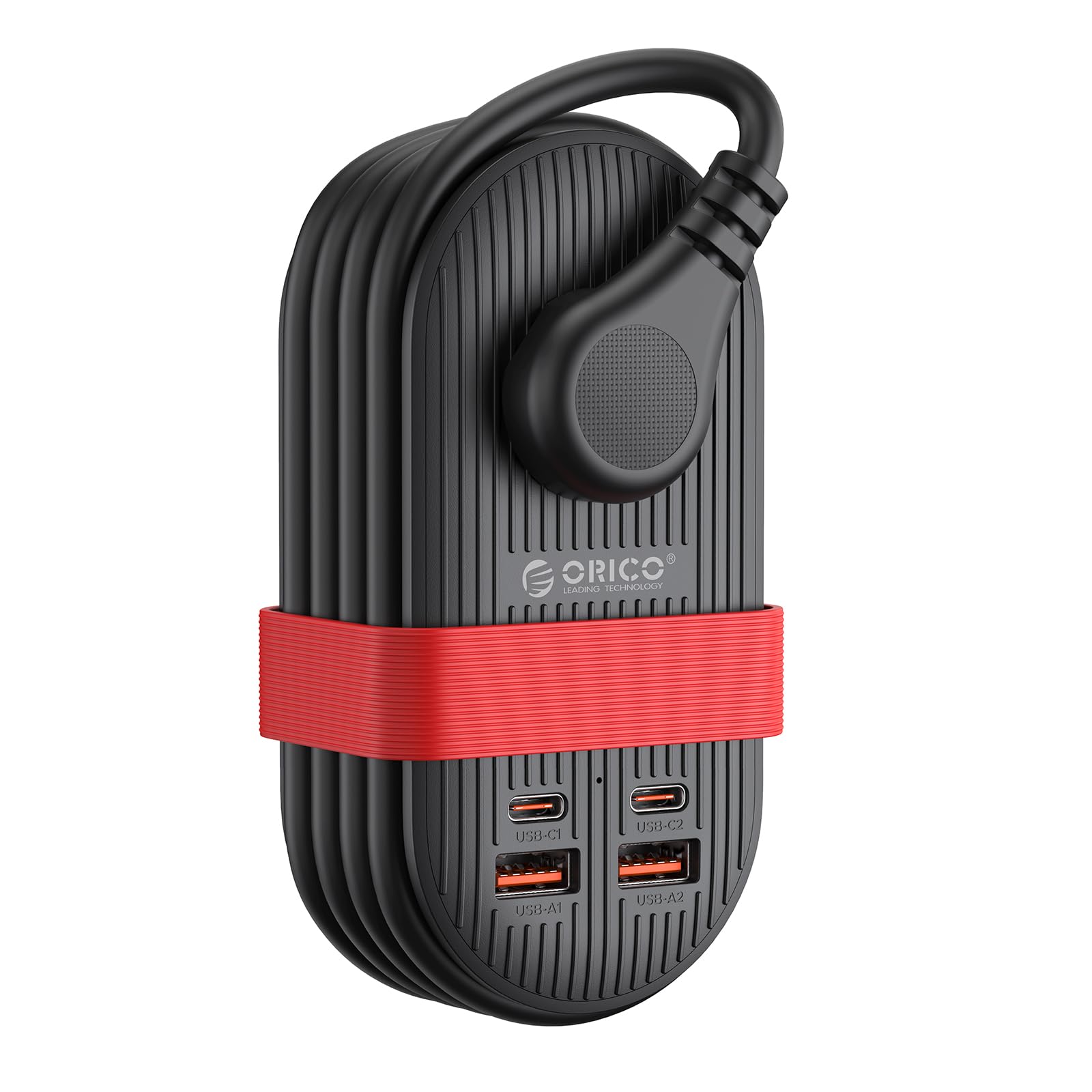
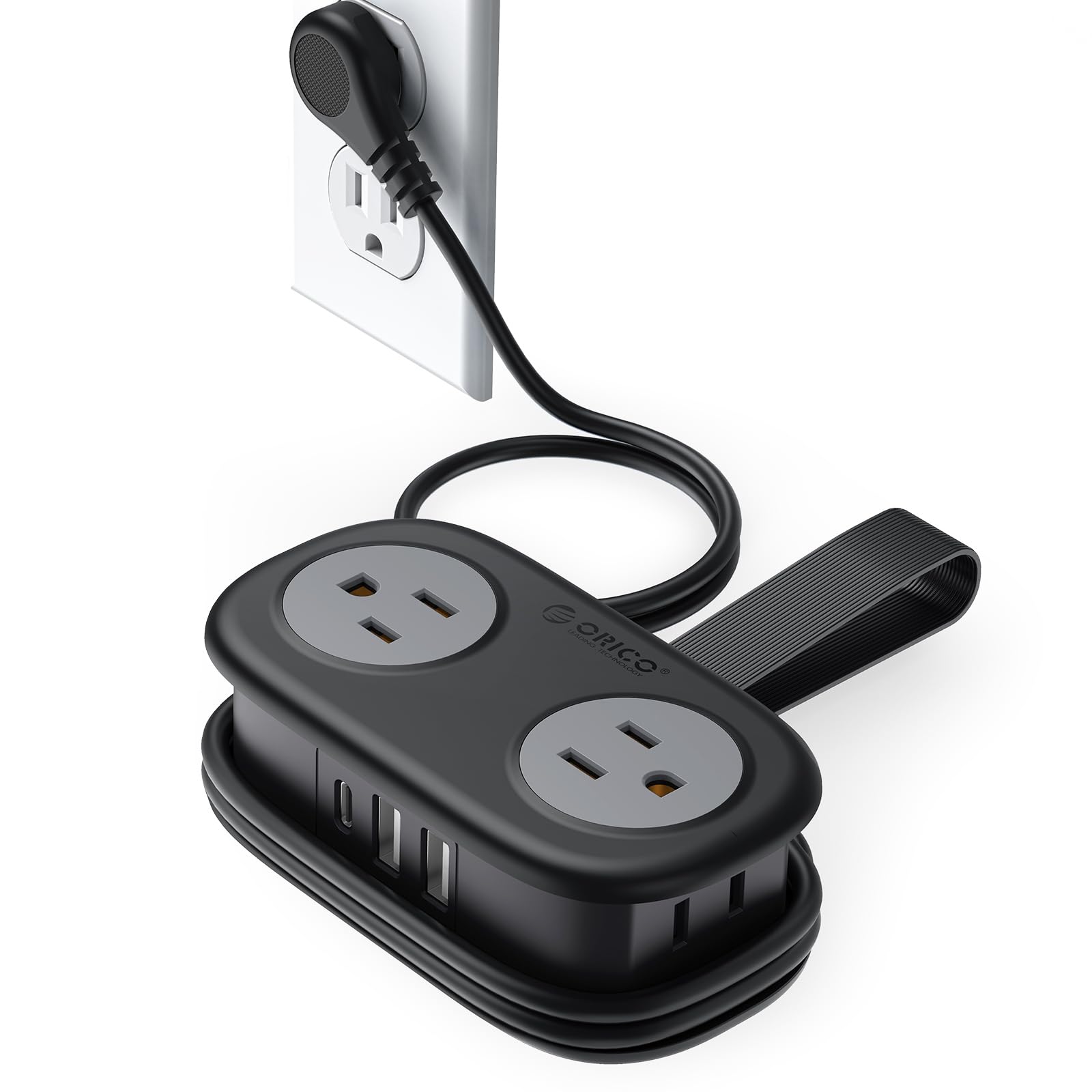
Four feet of cord that wraps around the strip's own body is the detail that earns this one a permanent spot in our bag. Packing a power strip usually means wrestling a coiled cord that has re-sprouted by the time you land; here the cord tucks into the housing and stays put. The plug helps at the other end too: at 0.39 inches thick and set at a 45-degree angle, it sits behind a hotel nightstand instead of pushing it out from the wall.

The numbers suit a family trip — four AC outlets, two USB-A and one USB-C, seven devices at once — and the outlet count is the real story. That is two more wall plugs than either Anker here, and wall plugs are what laptops, camera chargers and a CPAP actually need. USB ports cannot help with any of those, which is why the split matters more than the 7-in-1 badge. At 4.33 by 2.5 by 1.6 inches it takes up about as much room as a phone in the bag.

Two things to settle before you pack it. ORICO does not publish a wattage for the single USB-C port, so treat the USB side as phone-and-tablet charging and bring the laptop brick; if you want the strip itself to fast-charge a laptop, that is the Anker Nano's job. And with no surge circuitry inside, this is a travel tool rather than a desk protector — at home, plug the expensive gear into something else.

Bottom line: We pack this one by default: four real outlets, three USB ports, and a cord that disappears into the body at the lowest price in this group.

2

Anker Nano 67W

Anker Nano 67W

Laptop trips

Our Score 9.4/10
Check Price

Worth Noting

  • 13.9 ounces is heavy for a small bag
  • USB-A ports cap at 12W
Cord
5 ft
Weight
13.9 oz
USB-C Output
67W max
Outlets And Ports
2 AC + 2 USB-C + 2 USB-A

Sixty-seven watts through one USB-C port is what separates the Anker Nano from everything cheaper here. That is enough to charge a 13-inch laptop at full speed — Anker quotes a MacBook Pro 13 reaching full in just under two hours — while two AC outlets and three more USB ports pick up the rest of the kit.

What we appreciate is the shape: a 0.75-inch slab with the outlets on the face and the ports along the edge, so a hotel nightstand does not turn into a nest of cubes and dangling cables. The 0.35-inch flat plug and five-foot cord also give you a foot more reach than our top pick, which matters in rooms where the only free outlet is behind the television.

Weight is the trade. At 13.9 ounces it is roughly two phones in the hand, and you feel it in a personal item on a long walk through an airport. If everything you carry charges over USB, that weight buys you nothing and the ORICO is the lighter answer. Worth noting too: Anker does not list this one as cruise-approved, and whether it clears the pier depends on the line's current rules — check before you pack it.

Bottom line: Buy this if a laptop has to charge from the strip itself: 67W of USB-C and five more ports in a body flat enough for a seat pocket.

3

Anker Prime 140W

Anker Prime 140W

Power-heavy trips

Our Score 9.0/10
Check Price

Worth Noting

  • 16.2 ounces, the heaviest here
  • Only two AC outlets at a premium price
Cord
5 ft, detachable
Weight
16.2 oz
USB-C Output
140W max
Outlets And Ports
2 AC + 2 USB-C + 2 USB-A

The little screen is why you look twice at the Prime: it shows the watts going to each device as they charge, and it does that while the strip stays 0.7 inches thick. We expected to ignore it. What it actually settles is the question every multi-port charger raises — whether the laptop is pulling what it promised or quietly negotiating for half of it.

One USB-C port delivers up to 140W, and the strip splits that intelligently as you add devices across two AC outlets, two USB-C and two USB-A. The five-foot cord detaches, which makes the whole thing pack like a flat book rather than a wound-up extension cord. For a work machine and a personal laptop travelling together, that is the difference between one wall socket and a small charging station.

Where it gives ground is price and heft. At 16.2 ounces it is the heaviest pick here, and you are paying a premium for two AC outlets when our top pick has four for far less. The people who get their money back are the ones who would otherwise carry two laptop chargers and a phone brick; if that is not your trip, the Anker Nano does most of this for a lot less.

Bottom line: Our pick for a two-laptop trip — 140W, a live wattage readout, and a body thin enough to replace three separate chargers.

4

NTONPOWER 7-in-1

NTONPOWER 7-in-1

USB-C pairs

Our Score 9.4/10
Check Price

Worth Noting

  • Cord can slip off the wrap when wound loosely
Cord
4 ft wrap-around
Size
4 x 4 x 0.9 in
Flat Plug
0.31 in
Outlets And Ports
3 AC + 2 USB-C + 2 USB-A

Two USB-C ports and three AC outlets for about what our top pick costs is the whole argument for the NTONPOWER, and the 0.31-inch plug is the slimmest of the group — genuinely useful when the outlet sits behind a headboard and a normal plug will not seat. It is a four-inch round puck, 0.9 inches thick, with a four-foot cord that winds around the centre and a body that slides into a laptop sleeve.

The wrap deserves a word of care. Wound loosely, the cord can slip off the reel and you arrive with a loose loop tangling your chargers, so pull it snug against the body and it holds. The rest is straightforward: seven connections, a flat plug that stays put, and enough outlets to keep two people's phones, a tablet and a laptop alive in a room with one socket.

Bottom line: Our budget pick for USB-C: two USB-C ports and the thinnest plug in this group, for a good deal less than either Anker.

5

ORICO 65W GaN

ORICO 65W GaN

Budget 65W

Our Score 8.6/10
Check Price

Worth Noting

  • Ports can drop out under a multi-device load
Cord
4.43 ft with strap
Weight
10.2 oz
USB-C Output
65W max
Outlets And Ports
3 AC + 2 USB-C + 2 USB-A

ORICO has squeezed a 65W GaN charger into the same small body as our top pick and added a silicone strap so the 4.43-foot cord stays wound tight. On paper it is the sweet spot of this group: three AC outlets, two USB-C at up to 65W, two USB-A, all in 10.19 ounces.

The open question is what happens under load. That 65W is a single-device figure, and this is the one strip here where multi-device charging is genuinely uncertain — ports can drop out when a phone, a tablet and a laptop all pull at once. If you buy it, spend ten minutes at home with all seven connections live and confirm every port delivers before it goes in the suitcase. A strip that quits mid-trip is worse than one you left at home.

The rest we have no complaints about. The silicone strap holds the cord flatter than a bare wrap, the body is light enough to forget, and the 0.39-inch 45-degree plug is the same design as our top pick — which says something about how little ORICO had to change to fit 65W of charging hardware inside.

Bottom line: Good value on 65W USB-C in a tiny body, on the condition that you load all seven ports at home before trusting it on a trip.

How We Tested 14 Travel Power Strips

We built a shortlist of roughly 40 strips from manufacturer spec sheets, retailer best-seller lists, and the travel-gear forums where frequent flyers go to complain. Anything with fewer than three outlets, a body that wouldn't sit flat on a nightstand, or a cord that couldn't wrap and stay wrapped got cut. That left 14, all bought at retail so nothing arrived pre-selected, and we compared them on cost per usable port as we went.

Testing ran six months, in the places these things actually live: hotel rooms, a rental cabin, airport gates, a train tray table, and a desk at home. We weighed each one on a kitchen scale, then packed it into a carry-on front pocket next to a laptop brick to see what it crowded out. On arrival we plugged each into a loose wall socket and a stiff one, then tugged the cord to see whether it stayed seated. Cord alignment got its own check — where the cord leaves the body decides whether the strip hogs the second outlet in an older room.

For charging performance, we ran a laptop, a phone, and a tablet simultaneously, felt the bodies for heat after an hour, and timed a nearly dead phone to half full on each strip. Port capacity got a practical version: two chunky adapters side by side in adjacent outlets, plus a count of how many USB-C ports could hold full speed at once. Every label was read for surge protection, since a protected strip won't get past a cruise cabin check, and we noted which ones still felt solid after months of being shoved into bags.

How to Choose the Right Travel Power Strip

Count the plugs USB can't replace

A laptop brick, a camera charger, a CPAP, a curling iron: none of these runs off a USB port, and they are what makes a four-outlet strip worth carrying over a two-outlet one. Our top pick has four AC outlets; both Anker picks have two. If your trip is phones and a tablet, two is plenty and the smaller strip is the better carry.

The trap is the 7-in-1 label, which counts every port as equal. Two outlets and five USB ports is a phone charger with a token wall socket, whatever the number on the box. Read the split, outlets first and then USB-A and USB-C, and match it to the chargers you cannot leave behind.

Read USB-C wattage as a ceiling

Watts on a multi-port charger are shared. A 67W strip gives a laptop the full 67W only while the other ports sit idle; add a phone and a watch and the laptop's share drops. That is normal behaviour rather than a defect, and it is why the big number describes the ceiling instead of what every port does at once.

For sizing: 20W covers a phone, 45 to 65W a tablet or a 13-inch laptop, and 100W and up is what a 15- or 16-inch machine wants. The 140W Anker Prime is there for two laptops at once; for one, the 67W Nano is the more sensible spend.

Cord, plug and packed size

Two details decide whether a strip is pleasant or annoying. The first is the plug: a flat, angled plug of roughly a third of an inch slides behind furniture and reaches the outlet block under a hotel desk, where a standard plug plus a bulky adapter often will not fit at all. The second is what the cord does when it is not in use — a wrap-around body or a strap keeps it out of the way, while a loose coil tangles with everything else in the bag.

Then measure reach. Four feet is fine for a nightstand beside the outlet and short in a room where the only socket is across the floor; five feet, as on both Ankers, covers more hotel rooms. Weight runs from about ten ounces to over a pound, and the pound only earns its place when it is also carrying laptop-class power.

Surge protection and cruise rules

A strip with no surge protection is a plain extension of the wall socket, which is what most cruise lines ask for — surge-protected strips are the ones that get pulled out of bags at check-in. But the rule belongs to the line, not to the listing: some ships refuse any strip with AC sockets, and the decision happens at the pier, where there is no appeal. Check the current prohibited-items list for your ship before you sail.

The same fact matters at home. Without surge protection, none of these is the thing to put between a desktop PC and the wall; keep a real surge protector for that and treat a travel strip as a way to turn one socket into several.

Frequently Asked Questions

Final Verdict

There is no reason to overthink this one: the ORICO AP3 is what we pack. Four AC outlets, three USB ports, a cord that wraps into the body and a plug thin enough to sit behind hotel furniture make it the default answer for most trips, and it costs the least of anything here.

Spend more only for a specific reason. If a laptop has to charge from the strip itself, the Anker Nano's 67W USB-C is worth the extra money and the extra weight. If two laptops travel with you, the Anker Prime's 140W and its wattage display are the only thing in this group that covers both at once.